
Real Property Securitisation from the Viewpoint of Investors
1. Benefits to Institutional Investors
Since the burst of the bubble economy, institutional investors have become aware of the risks associated with direct investment in real property, such as the fluctuations in property values. As a result, investment in real property by institutional investors, such as life insurance companies and pension funds, has recently been decreasing (see Chart 4). However, demand for property investments is potentially high due to its importance to a diversified investment portfolio and its associated relative high returns.
Chart 4 Trends of Balance of Real Property Investment by Life Insurance Companies
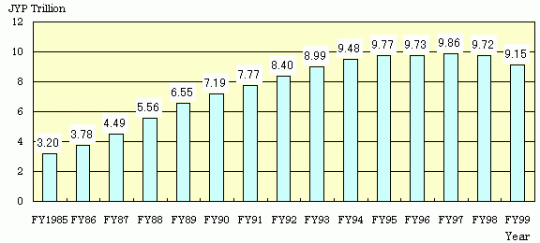
Source: prepared by Ministry of Land, Infrastructure and Transport using “Fact Book of Life Insurance” by the Japan Institute of Life Insurance
Real-property-securitised products have the following characteristics:
- Securitised real properties have high liquidity (ownership units can easily be sold and converted to cash) compared to direct investment in real property;
- Real property securitisation can potentially be structured in a way that reduces the risks associated with investing in real property; and
- Real property securitisation makes it possible for investors to readily to diversify across multiple properties, even when small amounts of funds are available for investment.
2. Benefits to Individual Investors
Individuals face the following obstacles with direct investment in real property;
- investment size is relatively large,
- management is costly and time consuming, and
- liquidity (conversion to cash) is low.
Therefore, real property securitisation will provide new investment opportunities to individual investors and can be expected to widen the options available to individual investors with respect to asset management.
