 |
 |
 |
|
| Ministry
of Land, Infrastructure and Transport Government Buildings |
| Environmental
Report 2005 |
|
|
 |
|
|
Government
Buildings Green Program Explanation 1 |
|
|
|
| The Government Buildings
Department designs, constructs, operates, and renovates buildings based
on a variety of environmental programs designed to ensure that government
facilities can be called "green government buildings" due to the
low burden they place on the environment. |
 |
Combating
Global Warming |
| |
|
|
|
|
 |
|
 |
|
|
Green
renovations completed on managed facilities requiring improvement
Target: 100% (fiscal year 2010)
Fiscal year 2002: 16%
Fiscal year 2004: 40% |
|
|
 |
|
 |
|
|
| |
 |
The department quantitatively assesses
CO2 emissions over the entire life cycle of government facilities
(LCCO2), including their design, construction, and operation.
The department is also working to conduct evaluations based
on Comprehensive Assessment System for Building Environmental
Efficiency (CASBEE). Promoting the reduction of the environmental
load created in the construction and use of facilities. |
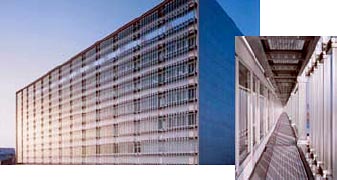
| Reducing
the environmental load: Reducing
energy loss and heat load through utilization of high-performance
insulation and sunlight shielding glass. |
 |
 |
Double-skin
external walls (Matsue Government Building) |
|
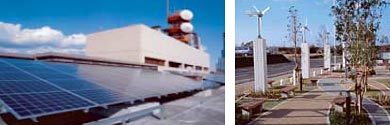
| Utilization
of natural energy: Effective
use of natural energy through means such as natural light, natural
ventilation, photovoltaic generation, solar panel hot water
supply systems and outside air cooling. |
 |
| |
Photovoltaic
generation
(Kobe 2nd Joint Government Building) |
|
| |
Wind power
(Tanegashima Joint Government Building) |
|
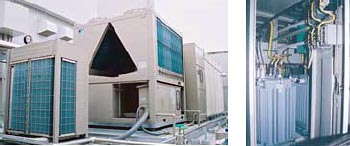
| High
efficiency: Effective and efficient
utilization of energy through leveling the power load, minimizing
transport energy, and utilizing high-efficiency light fixtures. |
 |
| |
Ice
thermal storage units
(Hiroshima Transport Branch Office) |
|
| |
High-efficiency
transformers
(Saigo Joint Government Building) |
|
|
|
 |
Creation
of a Recycling-oriented Society |
| |
|
|
|
|
|
|
|
|
|
Recycling
rates in government building and repair work
(Asphalt, concrete, construction timber)
Target: 100% (fiscal year 2005)
Fiscal year 2000: 77%
Fiscal year 2004: 98% |
|
|
|
|
|
|
|
| |
| |
The department emphasizes measures
such as the effective utilization of resources, building in
durability, and the utilization of recycled materials. |
| Eco-materials:
Reducing the environmental load through
the use of natural and recycled materials, timber from forest
thinning, and materials and construction methods that facilitate
disassembly. |
| <Major
examples of green procurement> |
| Category |
Item |
Unit |
Fiscal
year 2004
Quantity |
| Materials |
Ceramic
tiles |
m2 |
9,497.8 |
| Absorption
water chiller-heater |
Units |
24 |
| Construction
machinery |
Construction
machinery with special exhaust treatment |
No.
of projects |
301 |
| Construction
method |
Concrete
mass recycling method |
No.
of projects |
1 |
| Objective |
Rooftop
planting |
No.
of projects |
1 |
| m2 |
155.0 |
|
|
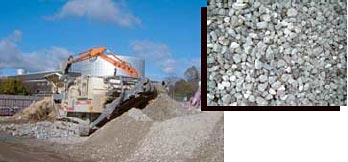
| Appropriate
use and appropriate disposal of construction byproducts:
Reduction of waste in the planning stage,
reduction and recycling of construction byproducts (consideration
of the use of disassembled materials by construction category). |
 |
| |
Concrete
mass recycling method
(The National Museum of Art, Osaka) |
|
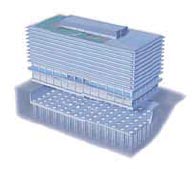
| Building
in durability: Building durability
into buildings by ensuring sufficient space (height of floors,
floor area, floor load-bearing capacity), utilizing construction
materials and methods known to be durable and earthquake-resistant,
and taking ease of maintenance into account in the design phase. |
 |
| |
Seismic
isolation retrofit
(Central Government Building No. 3) |
|
|
|
|








