|
 |
 |
|
| Ministry
of Land, Infrastructure and Transport Government Buildings |
| Environmental
Report 2005 |
|
|
 |
|
|
08
New Construction Initiative Example 2 |
|
|
|
 |
Japanese
Pavilions at Expo 2005 Aichi Japan (Aichi Prefecture) |
| |
|
|
|
|
 |
|
 |
|
|
In
constructing the Japanese Pavilions for this international exposition,
the theme of which is "Nature's Wisdom", the designers
took into account a wide range of environmental concerns. The
building has been planned as a means of promoting the reduction
of greenhouse gasses through measures such as energy conservation
and the utilization of alternative energy sources. In addition,
the building promotes the 3 Rs (Reduce, Reuse, Recycle) and
showcase technologies for preventing "sick houses,"
minimizing hazardous chemicals, coexisting with nature through
wall and rooftop planting, and monitoring and managing environmental
performance. The pavilions also use green icons to indicate
their environmental friendliness score. |
|
|
 |
|
 |
|
|
| |
 |
|
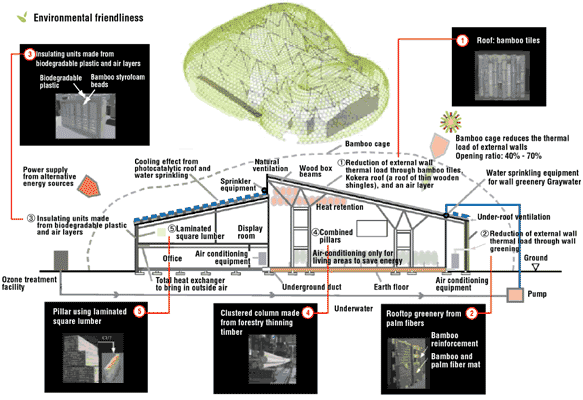
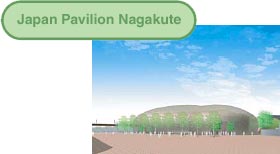
The building is an experimental model building demonstrating
how environmental concerns can be addressed. One hundred percent
of the power supply comes from alternative sources, the amount
of direct sunlight is reduced by means of a bamboo cage (a structure
like a bamboo basket), photocatalytic roof and rooftop planting
reduce the load on the air-conditioning, and the building makes
effective use of timber from forest thinning and biomass (recyclable
organic resources other than fossilized resources), demonstrating
the experimental use of new materials and technologies and the
use of natural materials. |
 |
|
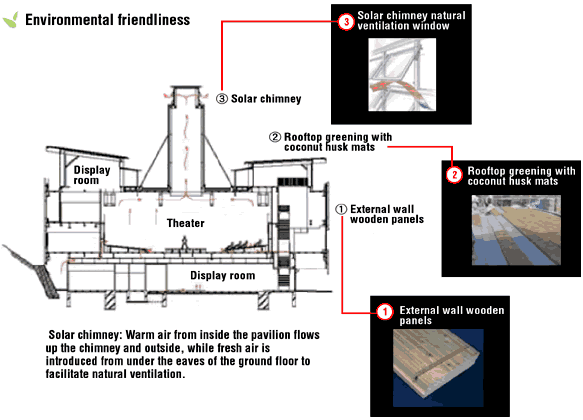
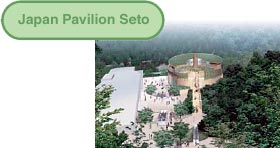
This building shows concern for the environment by minimizing
topographical changes, using wooden panels for external walls,
employing a solar chimney for natural ventilation, reducing
the air conditioning load by using geothermal heat, rooftop
planting using coconut husk mats, auto-responsive sun-sensor
glass, as well as making use of traditional Japanese technology
and the power of nature itself. |
|
|
 |
|