 |
 |
 |
(1) The transport operations of JR companies in FY1989 generally developed
favorably owing to sales efforts exerted in line with the purport of JR reform,
including vigorous business operations, and also to the revitalization of management
in addition to being supported by the domestic booming economy as in the preceding
fiscal year. As a consequence, the volume of transport during the past three
years following the privatization of the Japanese National Railways registered
increases of 3.9 percent and 7.3 percent a year in terms of passengers and freight,
respectively. The figures were a vast improvement compared with those over the
last five years (1.O percent for passengers and minus 9.5 percent for freight)
of the Japanese National Railways.
(2) In addition to the development of railway operations, efforts were made
to strengthen the foundations for management through the expansion of related
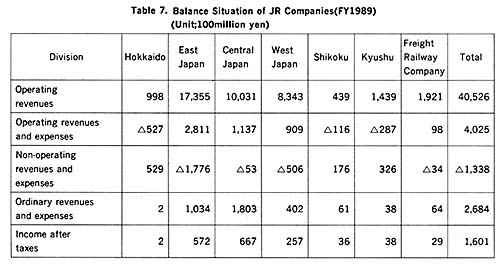
businesses. As a result, the combined business income of seven JR companies
in FY1989 totaled \4,052,600,000,000, up 3.9 percent from the previous fiscal
year, while their recurring profits amounted to 268.4 billion, an increase of
26.7 percent over the preceding fiscal year (Table
7).
(3) In FY1990, too, JR companies were wrestling assiduously with the management
of business operations to establish the foundations for management by forging
ahead with safety measures, the buildup of transportation capacity and the expansion
of services for users.
|
|
|