 |
 |
 |
Today, Global environment problems are attracting great international
concern, and the Ministry of Transport is playing a significant role in areas
such as global warming, destruction of the ozone layer, sea pollution, etc.
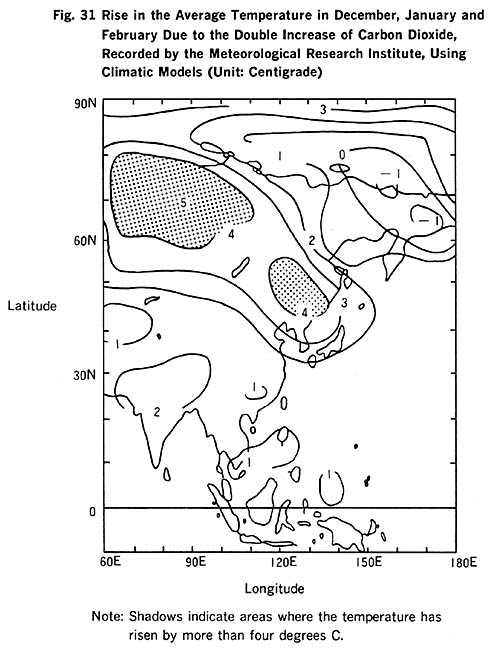
With regard to the problem of global warming, in particular, the ground
temperature, according to the Meteorological Agency, is estimated to rise by
somewhere between 1.2 degrees and 3.0 degrees C when the density of carbon dioxide
has doubled, and this is feared not only to cause the water level of the sea
to rise but also to exert a grave impact on the ecological system and human
society (Fig. 31).
Because of this, the government formulated in October 1990 "Action Programs
to Prevent Global Warming" whereby it decided to lose no time in implementing
feasible countermeasures.
The Ministry of Transport, for its part, will forge ahead with the following
countermeasures for global warming in line with such action programs:
(1) To improve and step up observation, prediction and forecasting systems.
(2) To promote the improvement of fuel consumption of motor vehicles, the
introduction of diesel and electric hybrid cars, a reduction of carbon dioxide
emissions from individual transport systems such as trains, aircraft and ships,
and countermeasures to curb such carbon dioxide emissions.
(3) To increase the efficiency of physical distribution, including the promotion
of modal shifts and use of commercial trucks, step up the transport capacity
of railways, and promote measures to activate bus services, thereby forming
transport systems involving less carbon dioxide emissions.
(4) To forecast the impact caused by the rising seawater level and establish
preventive measures to avoid damage.
Meanwhile, the improvement of international emergency systems is now being
hastened to deal with sea pollution accidents, including the massive oil spills
from tankers. The International Maritime Organization (IMO) pushed ahead with
work on formulating an "International Convention On Oil Pollution Preparedness,
And Co-operation, 1990" the primary purpose of establishing an international
cooperation system for the emergency prevention of oil-caused seawater pollution.
In November 1990, the treaty was adopted.
Parallel to such a move, the Ministry of Transport has decided to extend
positive technical cooperation to developing countries along the coast of ASEAN
sea areas, and, to promote, at the same time, the "OSPAR Plan" which is designed
to upgrade emergency prevention systems in those areas against possible large-scale
oil spill accidents. In January 1991, an international forum was held, and opinions
were exchanged on points at issue facing the areas under review in relation
to the promotion of the OSPAR Plan. As a result, it was agreed that an OSPAR
cooperation council be established with the basic understanding and approval
of the countries involved in a bid to study cooperative policies, and actions
to improve oil spill prevention systems in the ASEAN sea areas, and also to
hold the first meeting of the OSPAR cooperation council in Manila.
|
|
|