
 |
 |
 |
The Official Development Assistance (ODA), which constitutes the nucleus
of Japan's economic cooperation with the developing countries, consists of technical
cooperation and financial aid. The Ministry of Transport is involved in the
following projects:
(1) Technical cooperation
The technical cooperation includes the training of foreign trainees in Japan,
the dis-patch of Japanese experts, surveys and cooperation for development,
and the supply of equipment and materials. Fig.
9 shows the development surveys conducted during fiscal 1980. (Development
plans are worked out, and their feasibility confirmed, at the request of developing
countries for their regional or social development.)
(2) Financial assistance
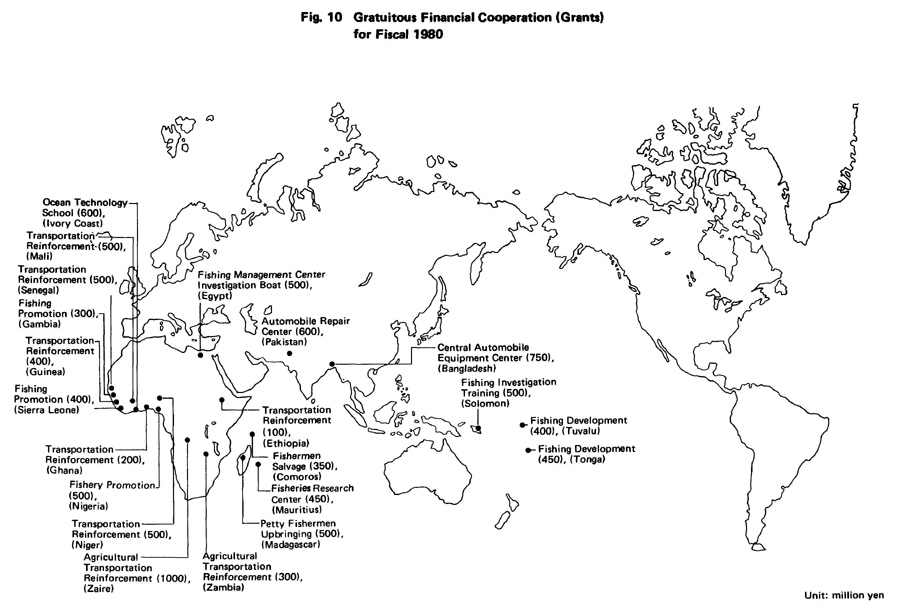
Fig. 10 shows the financial
assistance extended during fiscal 1980 on a gratis basis. Most of the funds
were used to purchase buses, trucks, and boats for fishing surveys and training.
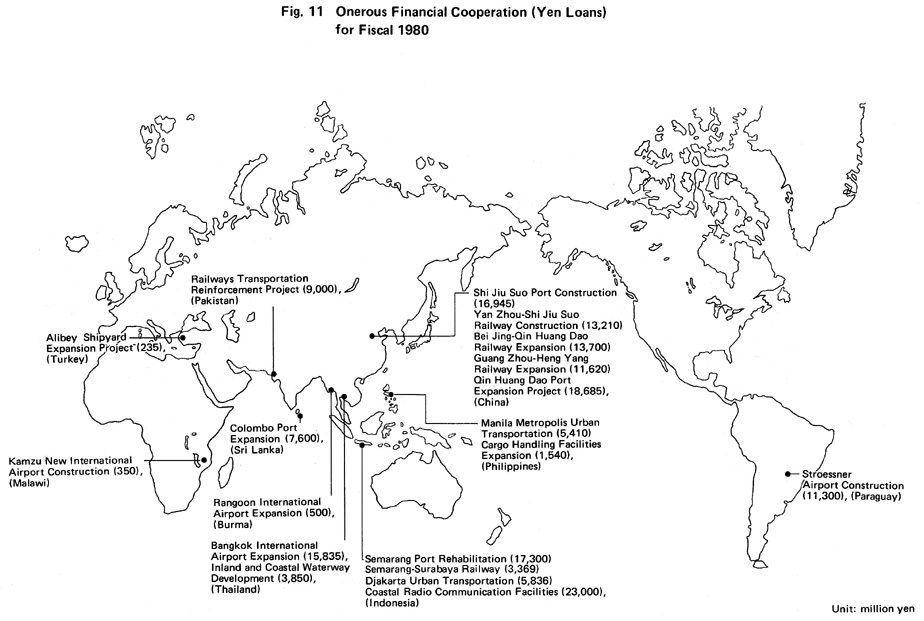
Fig. 11 shows the financial assistance
extended during fiscal 1980 on an onerous basis. It covered a total of 24 projects,
totaling ¥179.3 billion, including 5 modernization projects in China and 3 projects
in Indonesia.
In future tourism, greater emphasis will have to be placed in the promotion of international understanding rather than earning foreign currencies. Mindful of this, the Ministry of Transport plans to promote international tourism through the following measures:
| (1) | A general picture of present-day Japan to be given through unified campaigns in foreign countries; |
| (2) | Heart-to-heart contacts with foreigners to be promoted through the home-visit and home-stay systems and the establishment of international community centers: |
| (3) | "Travel-phones" to be set up, and guide books published, for
foreign visitors to enable them to travel in Japan by themselves as far
as possible. |
Oceangoing ships of Japanese registry manned by Japanese seamen have had
their international competitive power weakened in recent years in the face of
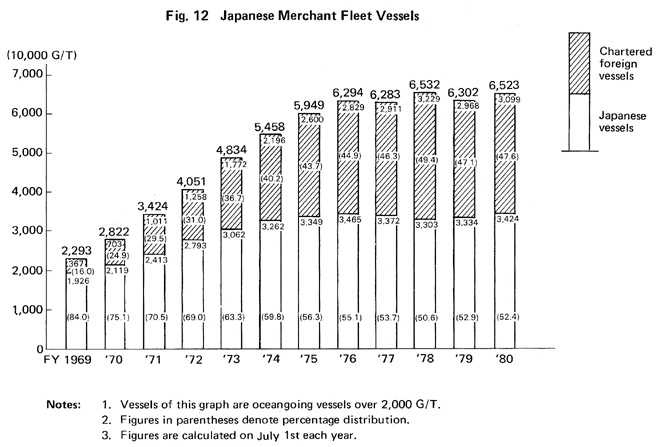
rising costs. While the size of the Japanese merchant fleet expanded as a whole,
Japanese-flag ships began to shrink numerically after a peak in 1972 and in
terms of tonnage in 1976. The Japanese merchant fleet has strengthened a tendency
to depend on chartered foreign vessels. (Fig.
12)
The Japanese fleet has played a vital role in the stable transport of energy
and other resources as a key industry constituting the basis of the national
economy. Moreover, the Japanese fleet is expected to undertake a very important
task of carrying alternative sources of energy like LNG, coal, and LPG, whether
in peacetime or in emergency. It is therefore desirable that at least the present
hauling ratio should be maintained. This means that Japan will have to have
about the same size of fleet in 1985. It is necessary to pay greater attention
to shifts to energy-saving, highly automated ships.
The international climate surrounding Japanese seamen has undergone a major
change in the following aspects:
(1) Competitive power of Japanese-flag ships on the decline
The competitive power of Japanese-flag ships has sharply gone down because
of increasing costs, including personnel expenses. To cope with this situation,
the shipping industry has been endeavoring to use automation technology as far
as possible, including the development of an M-zero ship with an unattended
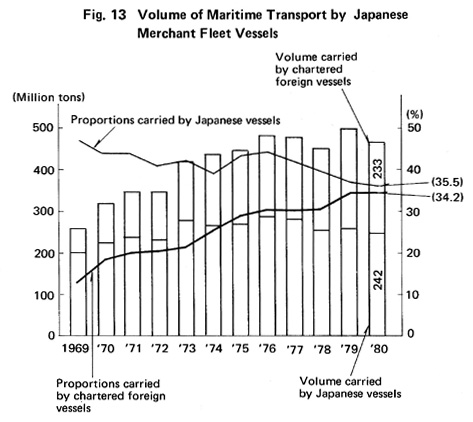
engine system. Despite these efforts, however, the dependency of the shipping
industry on chartered foreign vessels is rising. As a result, the number of
Japanese seamen on oceangoing routes has continued decreasing from 48,000 in
1968 to 38,000 in 1980. (Fig. 13)
(2) Demand for seamen of better quality
International demand for seamen of better quality has grown following a series
of stranding accidents involving tankers, and this question was discussed by
the IMCO (Intergovernmental Maritime Consultative Organization). As a result,
the International Convention on Standards of Training, Certification and Watchkeeping,
1978 (the STCW Convention) was adopted by the IMCO.
To cope with above-mentioned situation, it is urgently necessary to modernize
the present seamen's system or establish a new system capable of meeting with
technical innovation in vessels and of making the most of the ability of Japanese
seamen.
The Ministry of Transport has entrusted an ad hoc commission with the task
of studying a way to modernize the present seamen's system. In 1980, this commission
presented a "provisional image of seamen," envisioning a new management system
that unified the conventional lengthwise division of assignments, including
the, deck, engine, and wireless sections. Thus the work on the reform is progressing
smoothly.
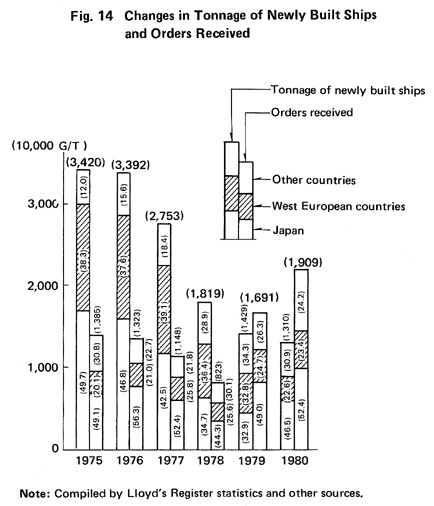
Faced with the slow growth of the world economy and the unstable energy
situation, the shipbuilding industry can hardly anticipate any spectacular performance
in the foreseeable future. (Fig. 14)
Japan's shipbuilders are expected to have precedence over foreign competitors
with regard to the price and quality of their products in the years ahead. In
order to continue their operations on a sound and stable basis in the future,
it is important for them to find a way to promote international cooperation
as well as strengthen their international competitive power. To achieve that
end, Japan has to develop and build various types of ships using new technology,
including energy-saving, super-automated vessels, and those navigable in icy
waters, while endeavoring to expand the application of shipbuilding technology
to other areas. At the same time, positive international cooperation has to
be promoted on both governmental and private levels.
Japan's automobile exports to the United States and Europe have raised
a major international problem in recent years because of the disparity in trade.
(46,000 units were imported into Japan in 1980, and 3 million 947,000 units
were exported from Japan.) The United States and Europe request that Japan open
its market to their products and restrict its export to them quantitatively.
Through consultations held between Japan and the United States, Japan and
Europe, since the beginning of 1975, there have been increasing numbers of requests
for improvements in the inspection procedures of imported cars. Japan has complied
with these requests wherever possible, and most of the issues have been resolved
up to now.
Japan has taken the following actions in this regard:
| (1) | Inspectors have been dispatched to the United States and Europe to conduct on-the-spot inspections. |
| (2) | Results of the examinations made by public organizations in Europe have been used in Japan for the inspection of imported cars. |
| (3) | Results of the examinations whose standards are equal with or above Japan's have been accepted. |
| (4) | Japanese laws and regulations related to automobile inspection procedures have been translated into English and liaison offices have been opened in the United States and Europe. |
Recognition has increased among the nations about the necessity to unify
the standards and certification systems with regard to automobile inspection.
At present, ECE-WP29 (Economic Commission for Europe-Working Party 29) is playing
a pivotal role in this work. It is necessary for Japan to strive to unify the
standards of automobile inspection in cooperation with other countries concerned.
Japan's automobile manufacturing technology with regard to the prevention
of public nuisances has won such high international recognition that increasing
numbers of requests for technical cooperation have been made from developing
countries where motorization is fast progressing. It is necessary for Japan
to deal adequately with these requests and promote international cooperation.
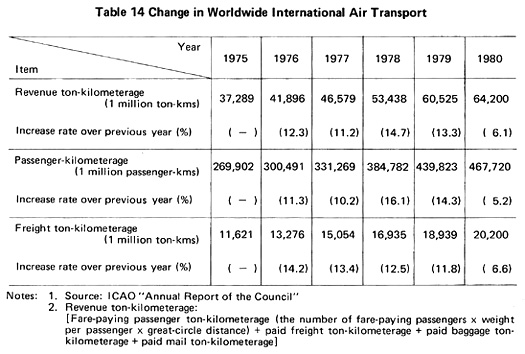
International aviation has been making steady progress along with the development
of the world economy. The aviation industry, however, faces such difficulties
as a tendency of excessive capacity caused by the introduction of large-size
aircraft and equipment, stagnant demand for passenger transport, and soaring
fuel costs. (Table 14)
Japan being a major demand-creating nation, there is increasing demand from
other countries that Japan permit more airlines to fly in, or increase their
flights to Japan, or introduce large-size aircraft.
The present situation of aviation talks with other countries is as follows:
| (1) | An air agreement was concluded with Finland in June 1981, bringing to the 36th country having air agreements with Japan. |
| (2) | Talks on a comprehensive revision of the Japan-U.S. Bilateral Air Transport Agreement are continuing with the positions of the two countries still remaining wide apart: the United States demands a substantial liberalization in Japanese aviation policy, while Japan calls for the elimination of inequalities in aviation rights and interests between the two nations and demands a construction of orderly aviation market with avoiding harmful effects by excessive liberalization. |
|
|
|