|
 |
 |
|
| Ministry
of Land, Infrastructure and Transport Government Buildings |
| Environmental
Report 2005 |
|
|
 |
|
|
Environmental
Policies, Targets and Plans |
|
|
|
| Kyoto Protocol Target Achievement
Plan |
The "Kyoto Protocol Target Achievement
Plan" is the Japanese government's plan for meeting its obligations
under the Kyoto Protocol, which came into effect on February 16, 2005.
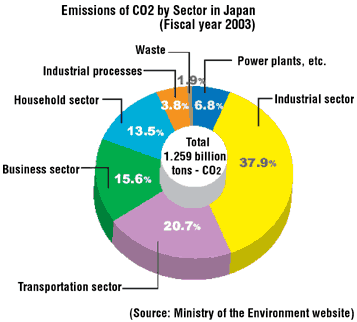
The global warming issue, the rise in temperature of the earth's surface
and the atmosphere caused by the increased concentration in the atmosphere
of "greenhouse gases" such as carbon dioxide, methane, and CFCs,
poses a serious threat to natural ecosystems and human beings due to flooding
and abnormal weather. Given the extent and severity of the predicted effects,
the reduction of greenhouse gas emissions is a global imperative of utmost
environmental importance. |
|
|
|
|
 |
|
 |
|
|
Ministry
of Land, Infrastructure and Transport Environmental Action Plan
The Ministry of Land, Infrastructure and Environment is responsible
for the nation's greening efforts to preserve, recreate, and create
Japan's beautiful environment (the reduction of the environmental
load through administrative activities). To promote the necessary
reforms, it has established the "Ministry of Land, Infrastructure
and Transport Environmental Action Plan."
The mission of the Ministry of Land, Infrastructure and Transport
has been to promote measures designed to create the hard and soft
infrastructures necessary for enjoyable life. These include a vibrant
economy, safety, a beautiful and favorable environment and rich regional
variety. The ministry has identified important targets in the four
areas of "Lifestyles," "Safety," "Environment,"
and "Vitality," and is promoting six reforms.
<< Six Reforms >>
| 1. |
Introduction
of life cycle management to the provision of social infrastructure
(working title) |
| 2. |
Conversion
to environmentally-friendly transport |
| 3. |
Creation of
an environmentally-aware market |
| 4. |
Sustainable
management of national land |
| 5. |
Creation of
a recycling-oriented society |
| 6. |
Promotion
of measures to increase capability to meet targets |
|
|
|
 |
|
 |
|
|
|
|
|
|
|
|
 |
|
 |
| Government
Buildings Green Program |
|
|
The Government Buildings Department established the "Environmental
Load Reduction Program on Government Facilities" in order
to promote comprehensive environmental measures based on the
"Ministry of Land, Infrastructure and Transport Environmental
Action Plan" and to play a leading role in the field of
public buildings. This program will provide an integrated framework
for the variety of measures promoted. Through the management
cycle (PDCA cycle) implemented for government building and repair
work, the department will work to reduce the environmental load
created over the life cycles of government facilities so as
to ensure comprehensive and effective results.
To achieve the greening of the building and repair of government
buildings, the department has established five major policies
to ensure that the environmental load is reduced in every stage
of a government building's life cycle, from conception and planning,
to the manufacture of the materials to be used, through construction
and operation to eventual disposal. From the next page, we will
introduce these five policies in detail. No doubt there is a
government building near you in which these policies are being
carried out. |
|
|
|
 |
|
 |
|
|
|
|
|
|
|
|
|
|
|
 |
Standards,
etc. |
Standards for the Environmental Preservation
Performance of Government Building facilities (March 2005)
Handbook for Combating Global Warming in the Use of Government Facilities
(March 2005)
In order to promote the Government Buildings Green Program, the department
created standards relating to the environmental preservation performance
of government buildings facilities and standards setting for the necessary
technical requirements for ensuring that the standards are met. |
|
|
|
|
|
|
|
|