.JPG)
.JPG)
 |
 |
 |
By the end of the 1960s, passenger transport maintained a close relationship
to the rate of increase of the real GNP and real personal consumption expenditure,
and continued to expand in volume. At that time, also, the structure of the
transportation system was going through changes.
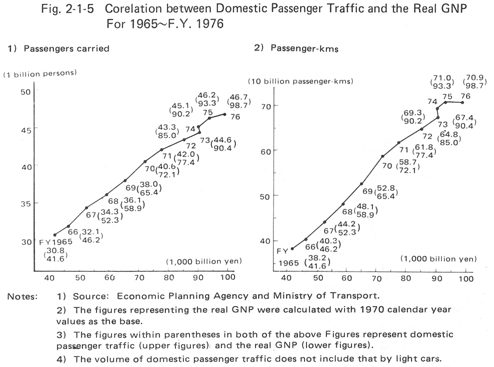
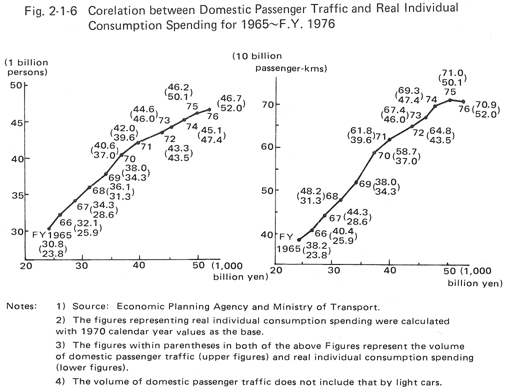
There were, however, changes in the volume of passenger transport starting
around fiscal 1971. Especially after the recession induced by oil crisis, the
upsurge in the voulume of passenger transport stagnated. In fiscal 1976, passenger-kms
carried finally de creased, compared with the previous fiscal year. This was
the first decrease in this category since statistical reports began being compiled
after the war (Figures 2-1-5
and 2-1-6).
The passenger-kms in domestic passenger transport increased 1.76 times
during the ten years from fiscal 1966 to fiscal 1976.
The increase in transportation demand was attributable to the preparation
of transportation facilities, an increase in traffic networks, and improvements
in transportation technology. In particular, the decrease in traffic networks,
and improvements in transportation time as a result of the preparation of truck
route system including the Shinkansen (New Trunk Line), airports and the networks
of highways were marked.
Passengers select transportation means on the basis of convenience, safety,
low cost, high speed, comfort, mobility and punctuality. As a result of improvements
in the national standard of living and the high economic growth rate, demand
for transportation which is fast, pleasant, and convenient has increased. Therefore,
there was a considerable change in the ratio of the share of each type of transport.
This changes in share was accelerated by the efforts on the part of those engaged
in transportation services.
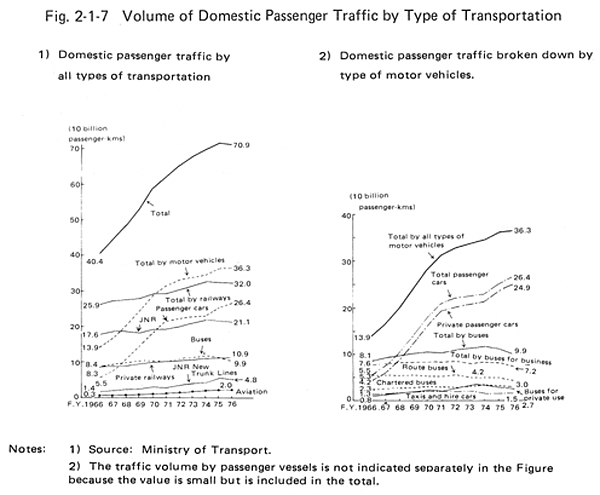
In the last ten years, the increase in passenger-kms can be broken down
by: 19.9% for railways, 73.5% for motor vehicles, 5.6% for aviation services
and 1.0% for passenger vessels.
Railways increased their total transport only 1.24 times during the ten
years: in fiscal 1976, the total share for railways fell to 45.0% (Figure
2-1-7). Of this, transport by the Shinkansen rose 3.32 times during this
period to account for a 6.8%in share in fiscal 1976 (3.6% in fiscal 1966). The
volume of transport by motor vehicles surpassed that for railways in fiscal
1971. It accounts a 51.2% share in total passengers carried in fiscal 1976.
As a result of the increase in the national income level and in the demand for
speed and convenience, private motor vehicles made a remarkable jump in the
transportation system: 35.1% in fiscal 1976 (10.3% in fiscal 1966). The volume
of domestic passengers transported by air is still low but increasing: passenger-kms
have increased 6.98 times in the last ten years, and the number of passengers
carried is now so great that one person out of four uses this mode of transportation
every year.
These high increases in domestic passenger transport by the Shinkansen,
motor vehicles and aviation show a stronger desire on the part of the public
for speed, mobility and comfort. These increases also show that the desires
of passengers is shifting toward more advanced transportation means.
Changes in the trends of passenger transport began to appear around fiscal
1971.
Transport by private motor vehicles accounted for 27.6% of the passenger-kms
as early as fiscal 1970. This increase in vehicular traffic caused a considerable
effect on passenger traffic as a Whole. Along with the increase in the number
of motor vehicles owned, the use of private motor cars also grew, but the average
frequency of use of motor vehicles begun to decrease. As a result, the increase
in the volume of transport by private passenger cars began to decline, starting
around fiscal 1971. Primarily affected by this decline, the total volume of
domestic passengers transported began to show a decline in the rate of increase
starting around fiscal 1971.
Further, the after-effects of the oil crisis and the shift of the Japanese
economy to a pattern of low, steady growth brought about considerable effects
on the domestic economy. The real consumption expenditures for fiscal 1966 through
fiscal 1973 rose an average of 4.8% per year, showing a steady increase. For
fiscal 1973 through fiscal 1976, however, real personal consumption expenditures
rose only 0.8% per year, showing a sharp decline. This change also appeared
in consumption behavior as well, and a restrained attitude toward consumption
spread to all sectors of personal consumption expenditures such as clothing,
food and housing. In addition, transport fares were revised upward from fiscal
1974 to fiscal 1976 and caused some sentiment of reluctance to travel. Consequently,
the passenger-kms carried during these three years fell from the average annual
increase of 7.6% for fiscal 1966 through fiscal 1973 to as low as 1.7%. Passenger-kms
in fiscal 1976 fell (-0.2%) from the previous fiscal year, which was the first
decrease since statistics began being prepared after the war.
Despite these general trends toward thrift by the public, however, demand
for consumer goods which meet individual tastes continue to remain relatively
firm, and diversive movements in the pursuit of a better life have been seen.
These movements show that the quality of the social structure, which was centered
around the secondary industries, has gradually been changing. Society, in general,
is moving towards a post-industrial, information oriented and service oriented
economy. They also indicate that the public has a desire and an interest in
a better life as a result of the increases in income level and expanded pastimes.
Despite the fact that the volume of domestic passenger transport has been declining
in its level of increase during the recent business recession, transport by
private motor vehicles, the Shinkansen and air, which all have features of speed,
mobility and comfort, have had average increases of 6.4%, 7.3% and 7.9% per
year, respectively in passenger-kms, which is relatively high.
Due to the change in the structure of personal consumption expenditures
in an economy of low and steady growth, the rate of increase in the demand for
domestic passenger transport is likely to decline, and great quantitative expansion
cannot be expected in the future. Under these circumstances, competition between
each type of transport will become more intense. Increased competition has already
appeared as a result of the series of transportation fare revisions.
An increase in transport capacity is a matter to be tackled. More importantly,
however, attention should be focussed on the better service which should be
achieved by Promotion of properties particular to each type of transport. Concurrently,
of course, considerations of such aspects as safety, low pollution and energy
saving must be taken. In view of these, transport technology must be improved
and each sector of the transportation industry must be coordinated so that an
efficient transportation system may be formed.
Concentration of the population in large city zones, which has slowed in
recent years, still continues to remain high: the population in the three major
city zones as of the end of fiscal 1976 accounted for 46.2% of the total population
of Japan. The "doughnut" phenomenon in population distribution is becoming increasingly
prominent as central areas have developed a mass of office buildings and land
for homes in these area is increasingly difficult to obtain.
The volume of traffic within the three major city traffic zones continues
to increase. In the last five years, the share rates increased for passengers
carried by private Passenger Cars and subways; remained unchanged for JNR and
private railways; and decreased for buses and taxis
(Figure 2-1-8(1), (2)).
Road congestion in large cities has not been improved to the great determent
of motor vehicular traffic in the urban areas. Overall, private passenger cars
began to decline in the level of share increases, but in the central areas no
increases at all were seen. This was due partly to the enforcement of parking
control measures. In addition, road congestion is having adverse effects on
the operational efficiency of public transportation such as buses and taxis.
In light of this situation, various measures have been taken since fiscal 1965
to decrease the use of private passenger cars in order to establish an efficient
traffic system with emphasis on the importance of public transportation.
The volume of transport by high-speed railways which are primarily designed
to connect central urban areas and suburbs has been rising, with the average
distance transported tending to increase. It is, therefore, necessary to proceed
with the preparation of highspeed railways in order to comply with the trends
in transportation demand. Thus far, the transportation capacity has been increased
by providing the service organizations with subsidies and with loans from state
owned banks. In addition, the joint operation from suburb to central area by
both subways in central areas and suburban railways, the air conditioning of
coaches and platform areas at stations, and improvements in the ingress/egress
and transfer facilities have also been made to improve the conveniences of urban
high speed railways and to promote their use.
Various measures have also been taken in order to improve transport by buses
and taxis which provide carefully-thought-out services in the day-to-day transportation
needs of the public. These measures were worked out on the basis of the Council's
for Transport Policy 1971 report entitled "Proper Positions of Buses and Taxis
in Large Cities and Necessary Measures to Be Taken". Specifically, the recommendations
fell into the following two areas: 1) improvements in transport capacity and
reliability of buses, for instance, reorganization of bus route networks, extension
of service time, improvement in the transfer functions of buses and railways,
and setting special and Priority lanes for buses, and 2) improvements in the
services of taxi, for instance, an increase in radio taxis with two-way communications
equipment. In addition, there were deliberations on an attempt to improve the
level of transportation services by public buses to that of private passenger
cars by the combination among a demand system (by telephone), a location system
and free alighting. This combination service has been tested in Tokyo and Osaka.
Also, additional public taxis have been put into service in order to provide
transportation after the termination of bus service.
Although the population in areas outside the three large city traffic zones
is stabilizing, in small towns and villages the population is still decreasing.
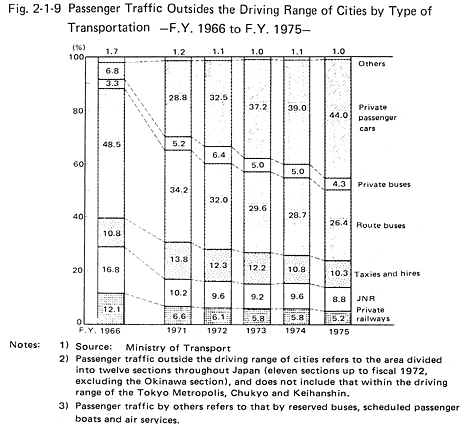
In areas other than the three large city traffic zones, Private passenger
cars have rapidly increased due to the progress in motorization. The share rates
of passengers carried by other types of transport such as railways and public
buses are gradually falling off (Figure
2-1-9). Railways, however, still continue to transport a large number, of
passengers in cities with relatively large populations. As a result, there has
been deliberation on the introduction of subways and monorails into some of
these cities with large population such as the so-called nucleus cities. Subway
operation was initiated in Sapporo starting in 1971, and progress is also being
made in other cities in the construction of subways and monorails or in making
plans for the introduction of such transport systems. Buses, however, encounter
traffic jams in local cities as well as in the larger cities, and have problems
with operational efficiency. Various steps have been taken to provide good bus
service and to maintain bus operations depending on individual situations.
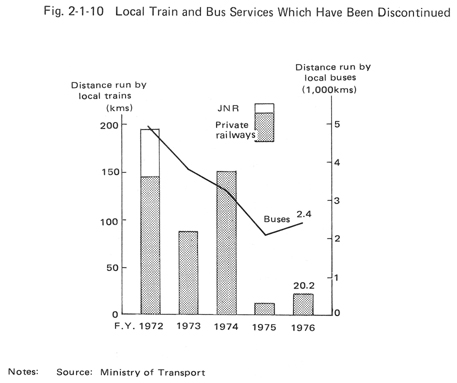
In rural areas where population has shown a decrease, the demand for transportation
has waned. In addition, the spread of private passenger cars has caused a decrease
in passengers carried by buses and other public transportation services. Also,
there have been sharp increases in the cost of transportation, particularly
in personnel expenditures. Consequently, the profits of many of the public transportation
businesses are down, and services have deteriorated in such ways as reduction
in runs and suspension or termination of service lines. Many of these transport
service companies are finding the maintenance of operation difficult (Figure
2-1-10). Under these circumstances, subsidies have been granted for the
maintenance of route and line services and purchases of coaches (as later mentioned
in Chapter 4). These measures have been taken to 'maintain public services vital
for the people who need public transportation means. Along with this, measures
have been worked out to convert railway transport to bus transport according
to actual conditions in each area. The Japanese Government will endevour to
intervene properly in these situations in close cooperation with local authorities.
|
|
|