 |
 |
 |
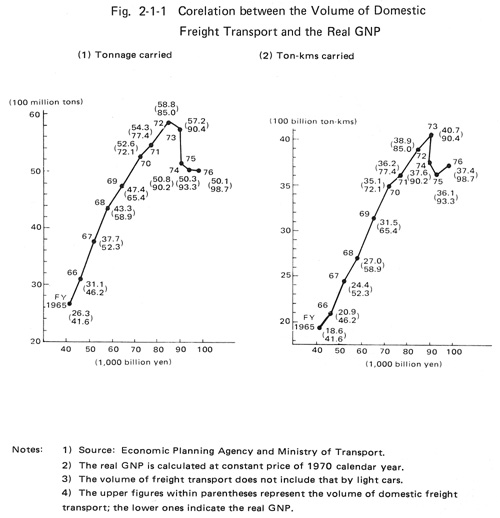
Up to around fiscal 1970, the volume of domestic freight transport, in both
tonnage and ton-kms had continued to increase, nearly at the same level as that
of real gross national product. A high rate of correlation was shown between
them (the correlation coefficient: 0.995 in tonnage carried and 0.998 in ton-kms).
This correlation, however, began to change around fiscal 1976 (Figure
2-1-1).
In and after fiscal 1976, the high level of correlation between these factors
was not seen as it had been before, especially in and after the oil crisis which
occurred in the fall of 1973. The tonnage carried began to either fall off or
level off, in and after fiscal 1973 despite the upward trend of the real GNP.
The same phenomenon was observed also at transportation in ton-kms in and after
fiscal 1974. Furthermore, the disparity between the volume of domestic freight
transport and the real GNP even began to widen.
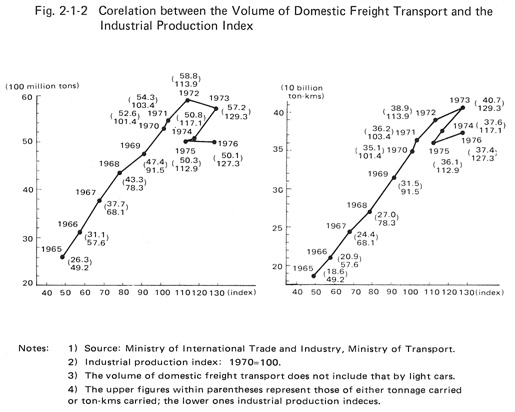
Such a trend also began to appear in the relationship between the domestic
freight transport volume add the output from mining and manufacturing industries
(Figure 2-1-2).
When these trends are analyzed, the following factors can be considered to
have had an influence: 1) development of tertiary industries and the increase
in their importance, 2) shift of the secondary industries to high processing
type industries, 3) economic growth mainly depending on increasing exports,
4) very low level increases in public and private investments, 5) development
in streamlining the physical distribution system in business sector, and 6)
decrease in purchase of goods in personal consumption expenditure.
The analysis above indicates that now, this time, can be considered to be
the time at which the Japanese economy has entered an era of stable but low
growth: the industrial structure is in the process of changing from the type
with emphasis on the mining and manufacturing industries to one with emphasis
on the tertiary industries; secondary industries are also shifting to high processing
type industries; and, further, businesses are expected to place greater importance
on streamlining the physical distribution system. Therefore, with the current
status of the economy and with the expected changes in the economic structure
the sharp increases in the volume of transportation which had been seen in the
past can not be expected any longer.
In view of this, transportation businesses are almost certain to encounter
difficulties from now on, in order to meet the severe demand of shippers who
will make their choice of transportation means and carriers based on availability,
low cost, safety, function, etc. The competition among transportation sectors
and transportation service companies is expected to be intensified by modernization
and streamlining.
The volume of domestic freight transport increased 2.19 times in ton-kms
in the eight years from fiscal 1965 to fiscal 1973, representing an average
increase of a high 10.3% per annum during this period. By type of transport,
the volume carried by motor cars increased 2.9 times and coastal shipping increased
2.58 times. The volume carried by railways increased 1.02 times, which was essentially
unchanged.
From these findings, we can see that the motor vehicle and coastal shipping
sectors continued to grow at a high level each year throughout the period of
high economic growth. The background and factors influencing this increase can
be analyzed as follows:
Transport by motor vehicles: First, demand increased for the transport of
metal and machinery products and light and miscellaneous products which are
transported in relatively small lots but which have high value, and therefore,
have a greater capacity for bearing transportation costs. Consequently, the
volume of transport by motor vehicles increased sharply in those fields of transportation
services. Secondly, industries and the population became more concentrated around
the Pacific belt zone throughout the period of high economic growth, and the
sharp increase in demand for transportation arising from this concentration
pushed up the volume of transport by motor vehicles. Motor vehicles, of course,
perform efficiently for medium and short distance transport. Further, progress
in road construction including highways and truck terminals construction and
in the development of large class trucks helped to expand the transportation
capacity by motor vehicles. Thus, the demands of industries which seek mobility
and availability in transport were satisfactorily met by motor vehicle transport.
Transport by coastal shipping: The volume of transport in this sector increased
sharply on the strength of the demand for transport of materials for key industries
such as petroleum, iron and steel and cement. This sharp increase comes from
the fact that the coastal transport sector responded to the changes in the energy
demands in the industrial structure and to the development of heavy and chemical
industries around the coastal areas with various measures to streamline and
upgrade efficiency. These measures included the operation of vessels for special
purposes, the preparation of wharfs for special use and automation in loading
and unloading work.
The decline in freight transport by railways was influenced by the following
factors: 1) Due to the changes in energy sources and to increased dependency
on natural resources from abroad, transport of primary products fell off. 2)
The shift in industrial concentration, due mainly to the construction of industrial
complexes in coastal areas located on the outskirts of large cities, shortened
transport distances. 3) Demand for the transport of secondary products increased
as a result of the changes in the industrial structure. The main reason for
the decline in freight transport by railways lies with the fact that the changes
in the economic structure developed in such a way that it became difficult for
railways to efficiently utilize their inherent characteristics. Freight transport
by the Japanese National Railways was affected by the continuing series of union-management
disputes which hampered the sable and efficient supply of transportation services,
lowered the confidence of shippers and, thereby, accelerated the decline of
the role of JNR.
The demand for domestic freight transport which had been exhibiting strong
upsurge trends, began to radically change starting in and after fiscal 1974.
The fact is that the increase in the volume of domestic freight transport
had already began to change in its proportional relationship with the high economic
growth around fiscal 1970. The demand, which peaked in fiscal 1973, began to
fall off and then continued to remain stagnant. Even in 1976, the level of transport
did not reach the peak level of fiscal 1973. The volume of transport remained
sluggish in each sector of the transportation in and after fiscal 1974, representing
trends which are different from the flow during the era of high economic growth.
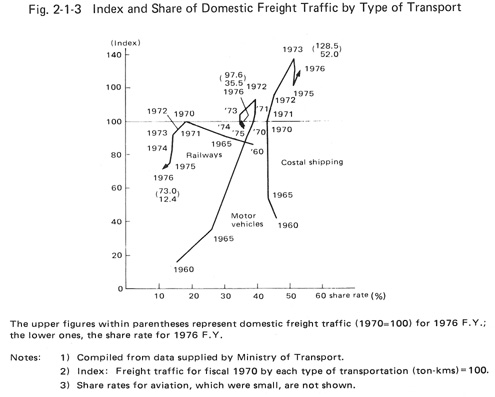
Transport by motor vehicles: The volume of transport and the share of this
sector, continued to expand throughout the period of high economic growth. However,
the rate of increase in and after fiscal 1970 began to decline. In fiscal 1972,
transport by motor vehicles reached a peak and then began to gradually taper
off, as did the rate of share handled (Figure
2-1-3). The decline can be considered to be attributable to the fact that
the volume of transport related to building materials decreased. Building materials
such as steel frames, which account for a considerable portion of motor vehicle
transport, suffered a decline as a result of the low levels of public and private
investments in and after fiscal 1973/1974.
Transport by coastal shipping: Coastal freight transport continued to rise
in and after fiscal 1970, especially in materials for key industries such as
petroleum products and iron and steel. In recent years, freight transport by
coastal shipping, after reaching a peak in fiscal 1973, fell off sharply until
fiscal 1975 in almost all of the major items transported. However, in fiscal
1976, it began to finally show signs of a recovery.
Transport by railways: While continuing to rise until Fiscal 1970, freight
transport by railways turned and tapered off after that fiscal year.
As seen from the above, transportation demand and the volume of traffic
by transportation sector changed drastically between the period when the nation's
economy enjoyed high growth and the period in and after fiscal 1973 when the
structure of the economy gradually began to adjust to a period of stable growth.
This is particularly true for the rate of share in freight traffic by type of
transport. The shares of the various transport sectors changed drastically during
the period of high economic growth, but, in the past few years, have shown low
levels of movement.
As the pattern of growth in the economy changes from the previous high growth
to stable growth, the pattern of freight transportation activities is also obliged
to change from an expansion in quantity to an improvement in quality.
Both the changes in the industrial structure and the advent of an era of
stable but low economic growth are the major factors which indicate that a great
increase can not be expected in transportation demand in the future.
There is, however, a growing demand from shippers that the costs of physical
distribution be reduced without lowering service. Therefore, businesses in the
transportation industry will be increasingly competitive due to the fact that
shippers are becoming increasingly selective when choosing the type of transportation
they will use. Flexibility, cost, safety and mobility are the factors about
which they are most concerned.
During the days of high economic growth extensive preparation of facilities
and investments in transportation equipment were needed in order to expand the
transport capacity. Now, however, the actions taken to help solve the transport
problems of that time have begun to bring about various other social problems:
For example, pollution problems such as the noise, vibrations and exhaust gases
which are produced during physical distribution activities, or social problems
such as traffic congestion. Streamlining of the physical distribution system
by curtailing useless transport is, thus, required to cope with these problems.
This effort will also help to stabilize the prices of resources and promote
energy saving in Japan.
Since the conditions in the transportation industry have changed competition
has become intense. Transport businesses have to restructure themselves in a
sophisticated manner so that they can provide stable and effective transportation
services to shippers which require a higher quality of transport.
Transport businesses are expected to establish an effective physical distribution
system along lines which will foster their inherent characteristics, and, at
the same time, in a direction which will establish a solid foundation for their
businesses.
Modernization and streamlining plans by each type of transport are as follows:
1) Transport by Trucks
Truck are the nucleus of freight transport in urban areas. However, the effect
of truck transport on road congestion in and around large city traffic zones
has worsened to such an extent that some measures have to be taken.
Consequently, a joint transportation system is currently being used for the
purposes of streamlining collection-delivery transport services in large cities,
cutting down on cross transport, raising the level of loads and reducing the
volume of vehicular traffic. Since the use of this transportation system has
proven to be effective in reducing costs of physical distribution and the traffic
volume, promotion of this system should continue to be made.
In addition, another plan under deliberation is to consolidate home delivery
of products connected with daily life such as newspapers, milk and department
store purchases. In 1976, under the guidance of the Ministry of Transport, joint
delivery of department store purchases was made in selected areas of Tokyo and
Osaka. This was implemented as a pioneer model. In 1977, joint delivery was
also made in selected areas of Sapporo and its environs with postal parcels
added to the department store purchases delivered.
Another plan under deliveration is to prepare joint delivery-reception facilities
at transport terminals to alleviate road congestion in urban areas and to control
pollution caused by traffic.
There are two types of transporters using trucks to deliver freight lots:
transporters for a limited area on a charter basis and that of regular route
services.
New types of services have recently appeared in these two areas. Some transporters
for a limited area on a charter basis have begun a Service using light trucks
for the joint delivery of small-lot freight.
Some transporters of regular route service have also begun a service for
the home delivery of small lots of goods speedily and with a high level of service.
The importance of the role of trucks in transport between areas is rising.
However, preparation of physical distribution bases such as truck terminals
is still behind the construction of roads. In this connection, therefore, the
arrangement of well-balanced and efficient transportation bases must be made
to prepare nationwide networks for physical distribution which will be applicable
to the pattern of stable economic growth.
2) Coastal Shipping
Coastal shipping met the needs of the growth of Japan's key industries and
the development of industrial complexes in coastal areas due to its capacity
for transporting large quantities at a low cost. This sector expanded in transport
volume, accounting for about half of all the domestic freight transport in ton-kms
carried.
Under these circumstances, the demand for coastal shipping is expected to
continue increasing with emphasis placed not only on quantity (increasing transport
capacity) but on improvement in quality (upgrading and streamlining). Consequently,
operators engaged in coastal shipping are expected to have difficulties that
they have never before encountered: for example, the modernization of vessels
and a reduction in transport expenses.
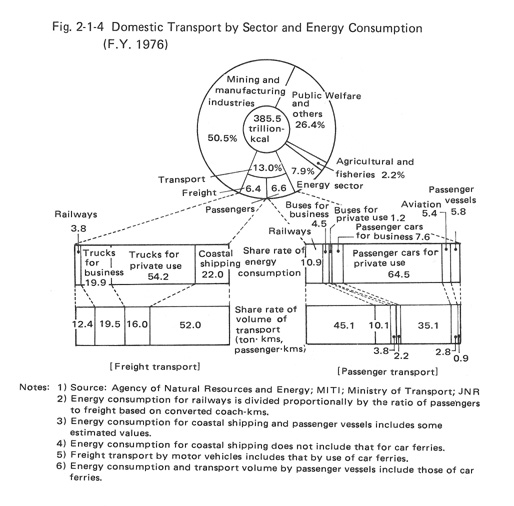
In the field of miscellaneous goods transport, coastal shipping has recently
been frequently discussed in connection with the issue of just how coastal shipping
should fit into the entire system of domestic freight transport. Sea transport,
as seen in Figure 2-1-4, has many
advantages over land transport from the standpoint of energy saving and the
effective use of the labor force. Based on the long-term perspective, it is
desired that the role of sea transport grow in the system of miscellaneous goods
transport between areas.
3) Freight Transport by Japanese National Railways
The volume of freight transported by JNR, which had been declining each year,
was 45.5 billion ton-kms in fiscal 1976. This volume was down 27% from fiscal
1970 when transport by JNR reached a peak.
In the field of mass transport and fixed pattern service, however, freight
transport by JNR has superior economic advantages. The volume of freight transported
by JNR in fiscal 1976 surpassed that by trucks in the land transport sector
for materials such as grains and chemical fertilizers. Transport of petroleum
by JNR also accounted for nearly half of the land transport of that item in
the same fiscal year. JNR should, therefore, continue to lay stress on mass
transport and fixed pattern I service from now on in order to streamline their
management.
4) Warehouses
Storage facilities should be constructed hereafter mainly at the strategic locations
in a national physical distribution network with appropriate capacity so as
to meet social needs. At the same time, a series of steps must be taken to strengthen
corporate structures, to expand the general materials distribution process,
and to jointly cooperate in distribution assignments so that the total warehousing
system may be reinforced.
5) Promotion for Systematization of Physical Distribution
Truck transport, coastal shipping and railway transport account for a major
part of the physical distribution system, whether within an area or between
areas. However, transport cannot be completed by only one mode. It is therefore
necessary to combine all of these physical distribution means into one organization
system, so these means meet the social needs.
Currently, a transportation system such as so-called freight liner or car
ferry which takes advantage of the quantity transport capabilities of railways
and vessels combined with the mobility of vehicular traffic has been established
and is in service in the physical distribution system. Although freight transport
by air is rising, a joint transportation system which combines the mobility
of motor vehicles with the speed of air transport must be formed
|
|
|