 |
 |
 |
The employment situation (source: Monthly Labor Statistics Survey, for firms with 30 or more employees) showed unfavorable movement. On the other hand, the number of employed workers for 1976 totaled 52,710,000, registering an increase for the first time in three years. For the supply and demand in the labor force, however, the effective ratio of job openings to job seekers for 1976, stood at 0.64, and continued to show an excess of job seekers over job openings. Regular employment in 1976 continued to decline in total employment. Employment in transport and communications began to decline from this fiscal year.
Wages of transport labor (cash earnings) for 1976 represented a moderate increase, 12.8% over the previous year. This increase level was lower than that of the previous year. This was attributable to the fact that the rate of wage increases settled during the spring labor offensive in 1976 continued to remain at a level less than 10%. The wage standard in the transportation industry is higher than that for manufacturing and all other industries.
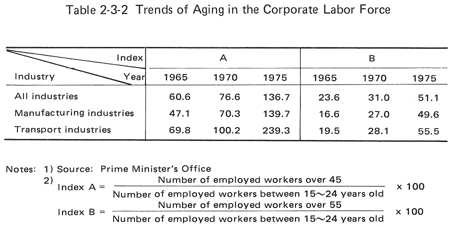
The aging of the labor force in all industries of Japan follows the recent
trend of aging in the Japanese population as a whole. Since the aging of workers
in transportation businesses advanced at a higher pace than for the average
of all industries and manufacturing, average age in the transportation industry
in 1975 finally surpassed that of all industries, even surpassing the average
age in the manufacturing industry (Table
2-3-2).
Aging has had an effect on corporate management. These are difficulties in
securing a young labor force, in an increase in the burden of personnel expenses,
and in personnel management. These factors will possibly present corporate management
with a series of new problems since the transportation industry is rather a
labor intensive industry. This aging factor may cause more serious difficulties
than anything else in the operations of transport businesses. Under these circumstances,
it is important to work out a new measure concerning the method of effectively
utilizing workers in the advanced age groups. It is also considered essential
to review series of such conventional matters such as employment, disposition
and promotion and the life long employment wage system, and to establish a new
system for the long term perspective.
|
|
|