 |
 |
 |
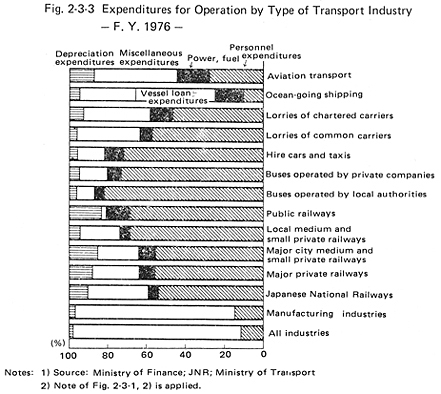
Management of domestic transport business operations has been improving in general. This was partly attributable to the revision in transport fares effective during the period of from fiscal 1974 to fiscal 1976. However, the demand for transport has declined as a result of the changes in the socio-economic structure. As shown in Figure 2-3-3, in transport businesses, personnel expenses generally account for a large proportion of the total expenses due to the high level of labor intensiveness. This is causing a continuous upward trend in increases in total expenses particularly in personnel expenses. Capital expenditures necessary to maintain and improve transport services are also expected to rise further in the future. Consequently, the management of transport business operations is expected to become generally more difficult from now On.
Transport business companies in general have been devoting their streamlining efforts to finding an economy of scale, and to the development of specialized means of transportation in order to reduce costs. Efforts have also been made to increase the efficiency of the transport labor force by automating and mechanizing various work. In view of this situation, transporters in the fields which require a large labor force should step up labor saving and streamlining in order to cope with the expected increase in costs. Further, a great deal cannot be now expected concerning the rise in the demand for transport in the future. It is then expected that competition between companies and between transport sectors will become increasingly more intense. Under these circumstances, each company will have to make full-scale efforts to monitor the changes in the transport structure in order to be able to make the best use of their characteristics. Efforts to stimulate, absorb and increase the demand for transport will have to be made by providing services that meet the needs of passengers and shippers. In this way, the companies will be able to form an efficient transportation system as a whole in the future.
Transport fares should be set by the transporters themselves on the basis
of their strenous efforts to work out further rationalization. Under this principle,
when personnel and/or non-personnel expenses can not be sufficiently absorbed
by an increase in labor productivity, costs can be off-set by a revision in
transport fares. At present, however, the competition among companies is expected
to become increasingly stiff because of the current trend of a decline in total
demand for transport. In addition, the standard transport fare for each type
of transports has been increasingly affected by the long-term and short-term
trends in demand. It is, therefore, necessary to pay due consideration to the
method and the time of revising transport fares from now on. In this respect,
revision must be made after full-scale deliberation concerning how transport
fares should be set for different types of transport and the revision of the
uniform transport fare system of JNR.
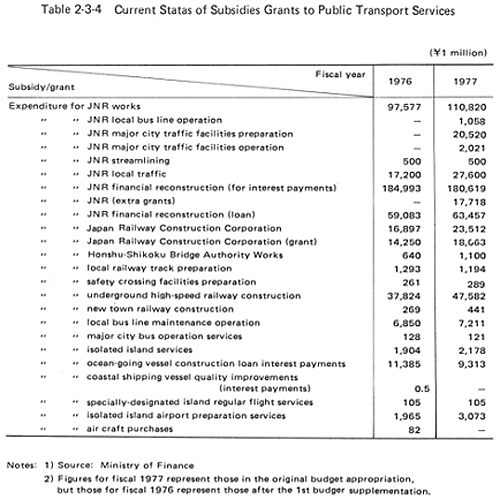
Further, a partial government subsidy will be necessitated when it is realistically
difficult for transport users themselves to fully bear the financial burdens
for maintenance of local transportation routes as well as for preparation of
urban traffic and other basic transportation facilities. The recent trends in
the subsidy supply by the government are as shown in Table
2-3-4.
|
|
|