 |
 |
 |
Efforts were made by UNCTAD to adjust such north-south problems in shipping
as adoption of the national flag discrimination policies taken by developing
countries. There were, however, some countries among the developing nations
that instituted a one-sided national flag discrimination policy. To cope with
this situation, Japan also enacted a law concerning a special measure against
the disadvantageous treatment per formed by foreign countries to Japanese ocean-going
shipping operators", which was enforced in July, 1977.
Further, the advancement made by Eastern European countries in shipping has
been a threat to advanced shipping nations. It is considered necessary for Japan
to proceed with a plan to take effective countermeasures in this situation in
cooperation with other countries.
Meanwhile, the moves over the safe passage across the Malacca-Singapore Strait
have been increasing in importance. The three countries in this area compiled
a bill for the restriction of passage through the strait. It calls for over
a 3.5 meter distance between the bottom of a ship and the sea bed and the necessity
of enforcing a separated two way passage system. In September, 1977, this restrictive
bill was debated at IMCO.
1) Current status of ocean-going shipping:
The tonnage carried by the Japanese mercantile meet has been increasing in
both exports and imports in 1976. The volume of transport by container vessels,
in particular, showed a sharp increase. In addition, although the world shipping
market remained sluggish, Japanese oceangoing shipping businesses in fiscal
1 976 showed recovery reflecting the steady exports. There was, however, a clear
discrepancy in the business results between the companies.
2) Current status in employment of seamen:
The effective ratio of job opening to job seekers for seamen continued to
sag in 1976, while the rate of reserve hands of seamen on land to total seamen
employment reached a high 69.7% as of October, 1976; thus, supply and demand
of seamen continued to remain unbalanced. In addition, the proportion of oceangoing
seamen, in the middle to high age groups increased. Thus, it will become more
difficult for shipping companies to cope with the employment and management
situations expected to arise in the future.
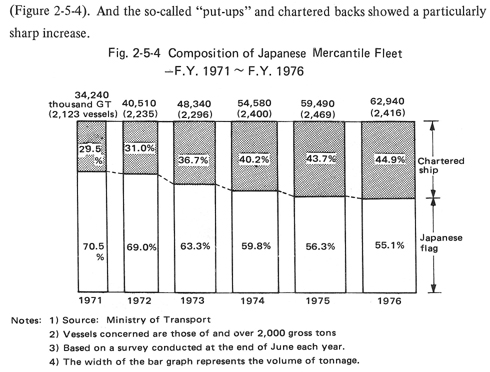
3) Decline in the international competitiveness of Japanese vessels and structural
changes in the Japanese mercantile fleet:
The sharp increases in various expenses in recent years, especially the rise
in expenses for seamen has caused a steep decline in the international competitiveness
of the Japanese mercantile fleet. Consequently, the Japanese mercantile beef
has changed substantially in structure: the volume of foreign chartered ships
increased sharply. (Figure 2-5-4).
And the so-called "put-ups" and chartered backs showed a particularly
sharp increase.
4) Future issues:
The direction in which Japan's shipping will go in the future should be decided
after careful deliberation. In these deliberations, the importance of shipping
to our country should be taken into account and the basic premise should be
that Japanese ships with Japanese crews be the pillar of the Japanese mercantile
fleet.
In view of the expected future trends in Japan's shipping industry, in November,
1976, the Minister for Transport asked the Shipping and Shipbuilding Rationalization
Council about Japan's oceangoing shipping policy. In February, 1977 the Minister
for Transport asked the Labor Relations Commission for Seafarers for information
concerning the basic policies expected to be applied for employment of seamen
in the future. Discussion on these matters has been under way.
Japan's share of aviation in world international aviation transport have
been increasing in both passengers and freight carried, registering 4.7% (passenger-kms
based) and 6.9% in 1976 (ton-kms based).
In addition, negotiations have been conducted between the U.S. and Japan to
revise the U.S.-Japan Aviation Agreement to straighten out the disequilibrium
in the rights and interests of line assignments and transport capacity between
the two countries. In recent years, demand has been increasing, particularly
by developing countries, that economic matters such as transport capacity, charter
flights and air fares be deliberated not only by IATA but on a government-to-government
basis. In April, 1977, a special ICAO transport conference was held.
With regard to the recent occurrences of many highjacking incidents, the
Japanese Government decided in October, 1977 to establish the "highjacking and
other inhumane violence preventive measure" headquarters. The headquarters was
expected to work on six areas of enforcement for highjacking preventive measures
such as anti-Japanese Red Army measure, thorough inspection for safety, etc.
|
|
|