 |
 |
 |
(1) International passenger transport
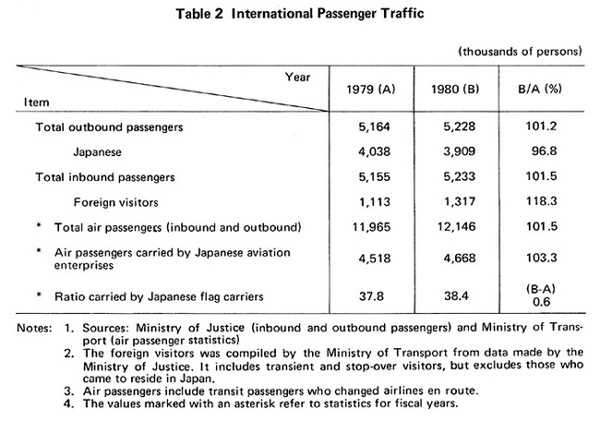
The trend of international passenger transport in Japan in fiscal 1980 is
shown in Table 2.
The trend of foreign visitors to Japan had the following features: 1) the
number of foreign visitors to Japan increased from almost all countries: 2)
as a result of the liberalization of emigrations in Taiwan (January 1979), the
number of visitors from Taiwan increased sharply. The increase rate of foreign
visitors to Japan was the highest since 1970 when the World Exposition was held
in Osaka.
The trend of Japanese tourists overseas had the following features: 1) the
number of male tourists, mainly those of middle age, decreased: 2) short-distance
trips to the Republic of Korea, Taiwan, and other Asian countries decreased
sharply. The number of Japanese tourists overseas decreased for the first time
since 1964 when overseas travels were liberalized. The 1980 figure was below
the 4 million mark reached the previous year.
(2) Domestic passenger transport
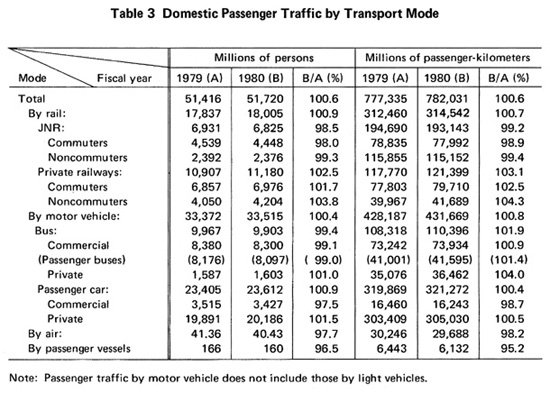
Due to sluggish personnal consumption, domestic passenger transport in fiscal
1980 registered a total of 51.7 billion persons, and 782 billion passenger-kilometers,
both up 0.6% over the previous fiscal year, in contrast to the steady increases
in fiscal 1978 and 1979.
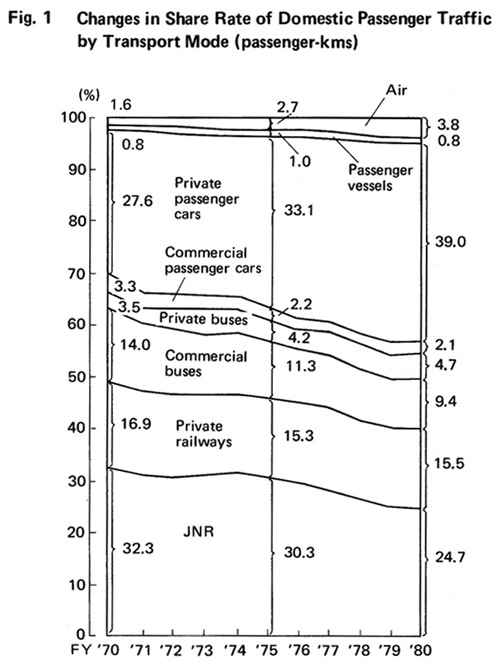
Transport in fiscal 1980 had the following features: 1) the activities of
various transport means, excluding the private railways, declined or leveled
off; 2) the increase rate of private cars fell sharply; and 3) air transport
suffered a setback for the first time in 14 years. (Table
3 and Fig. 1)
(1) International freight transport
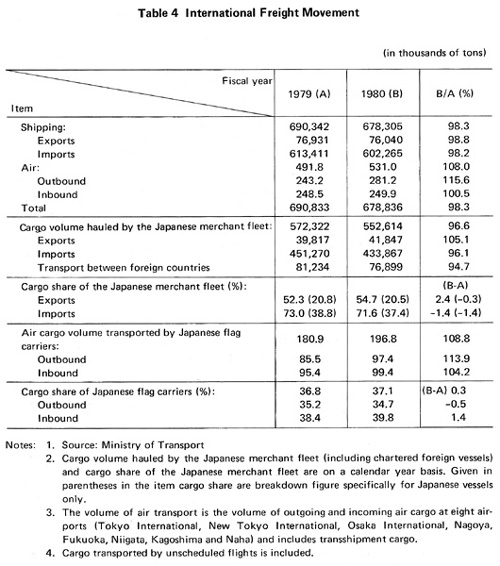
Japan's international freight transport by oceangoing shipping in fiscal
1980 in terms of tonnage decreased by 1.2% for export and 1.8% for import, respectively,
from the previous fiscal year. By item for export, automobiles increased by
26.0%, and machinery and electric equipment by more than 20%, while steel and
cement showed conspicuous decreases.
By item for import, coal increased by 22.9% because of its growing demand
as a substitute for oil. Lumber decreased by 17.5% due to stagnant demand from
housing. Crude oil also decreased by 9.5% since its demand had been curbed by
soaring prices.
Japan's freight transport by international air during fiscal 1980 saw a sharp
15.6% increase for export in terms of tonnage over the previous fiscal year,
thanks to the marked increases in such items as electric equipment and precision
instruments. Imports rose by only 0.5% although the increase rate surpassed
the previous year's level. However, it was far below the 15.7% achieved in fiscal
1979. (Table 4)
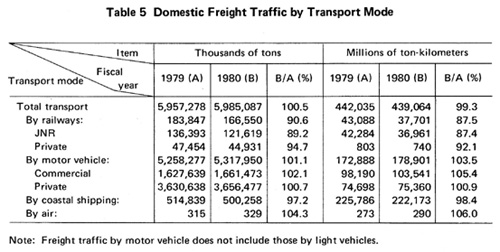
(2) Domestic freight transport
The increase rate of freight transport, which increased steadily in fiscal
1978 and 1979, fell sharply in fiscal 1980 due to stagnant business and other
factors. The total volume of transport reached 5.99 billion tons, higher than
the previous fiscal year's level which was the highest ever, though the increase
rate was only 0.5%. In terms of ton-kilometerage, it registered 439 billion,
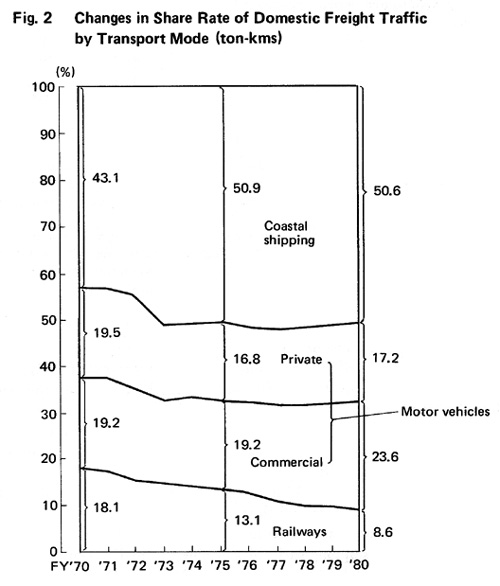
a decrease of 0.7%. The decline was the first since fiscal 1975. (Table
5 and Fig. 2)
Freight transport in fiscal 1980 had the following features: 1) all the transport
means suffered setbacks or stagnant growth in their activities; 2) the stagnation
was conspicuous in construction materials and oil products which normally take
a large portion of freight transport; 3) coastal shipping suffered a decline
for the first time in five years in terms of both tonnage and ton-kilometerage;
and 4) the JNR, which has been suffering a long-term declining tendency, registered
a decrease of more than 10% in terms of both tonnage and ton-kilometerage.
|
|
|