 |
 |
 |
(1) Effects of Appreciation of Yen and Drop in Oil Prices on Transport Economy
International economic changes since the autumn of 1985, such as the appreciation
of the yen against the dollar and the drop in oil prices, were so drastic and
had a great effect on the Japanese economy.
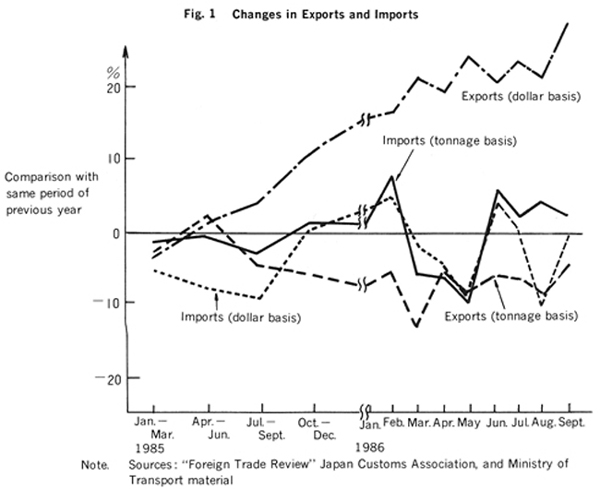
As for effects on the demand for transport, export goods showed a trend of growth
on a dollar basis due to the J-curve effect, but a trend of stagnation was evident
in the export volume on a tonnage basis. (Fig.
1)
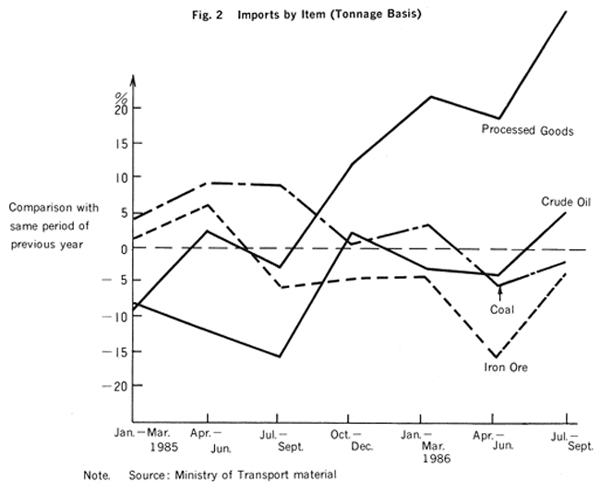
As for import goods, the effect of the appreciation of the yen was not
conspicuously evident as a whole both on a dollar and a tonnage basis. By item,
however, such raw materials as crude oil and iron ore decreased, whereas such
processed goods as machinery and foodstuffs showed large increases. (Fig.
2)
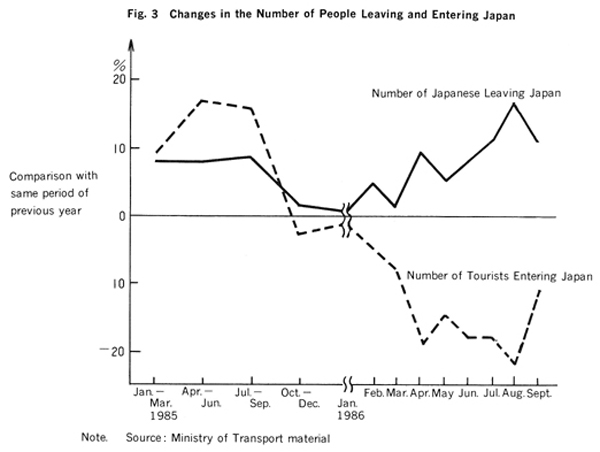
As for effects on international tourists, the number of Japanese traveling
abroad has sharply increased, and the number of foreign visitors to Japan has
sharply decreased, particularly since the beginning of fiscal 1986. (Fig.
3) The decrease in the number of foreign visitors to Japan was due mainly
to the sharp appreciation of the yen and due partly to a reactionary decrease
in the number of foreign visitors to Japan after the close of the International
Science and Technology Exposition in 1985.
As for effects on domestic cargo transport, a trend of decrease in demand
was becoming evident as a result of decreased exports, although such a trend
was not yet so conspicuous as a whole.
As for effects on business operations, such international businesses as oceangoing
shipping and shipbuilding were adversely affected by exchange losses caused
by the appreciation of the yen. On the other hand, Domestic transport businesses
benefited from reduced fuel costs.
(2) Responses to Yen's Appreciation and Drop in Oil Prices
While anti-recession measures were taken for the oceangoing shipping and
shipbuilding industries, exchange profits from the appreciation of the yen and
the drop in oil prices were shared with consumers by reducing air fares for
passengers leaving Japan in relation to fares for those leaving other countries
in international air transport, and by expanding or instituting various fare
discount systems in domestic air transport. Other public transport systems also
implemented such measures as improving their services or maintaining the present
fares as far as possible.
The increase in the international cargo volume to and from Japan has remained
at low level in recent years, irrespective of its economic growth. There have
been structural changes, such as stagnation in raw material transport caused
by energy-saving and resource-saving tendencies among industries and increased
trade of finished products caused by changes in the industrial structure and
progress in international specialization.
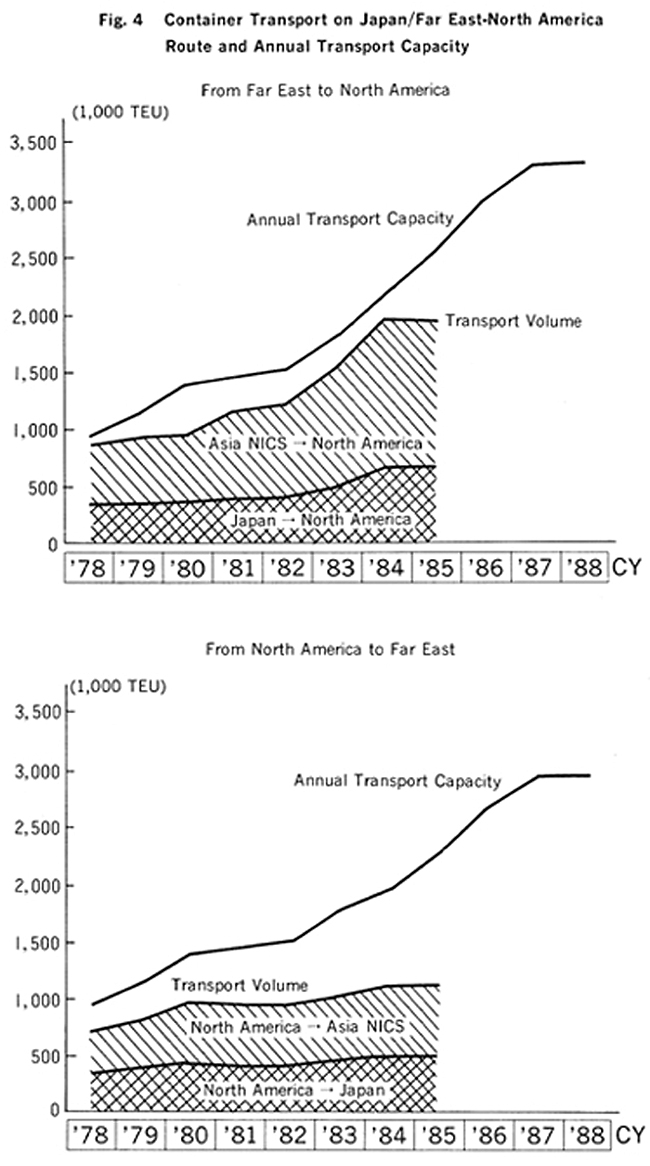
Despite the increased trade of finished products capable of bearing comparatively
high transport costs, freightage has gone down in liner shipping as well as
that in tramp shipping. This is due chiefly to the declined performance of liner
conference under the influence of the new Shipping Act of the United States.
(Fig. 4)
With the increase in the international flow of high-valued and small-sized
manufactured goods, international air cargo transport are making progress and
international multimodel transport is required by shippers more.
As for the financial situation of 40 companies as recipients of interest
subsidies regarding the past contracts for fiscal 1985, their combined earnings
totaled \2.447,6 trillion, recording a decrease of \155.5 billion (6.0%) from
the previous fiscal year, due to the simultaneous recession in the three fields:
Liners, trampers and oil takers, and to the sharp appreciation of the yen in
the latter half of fiscal 1985.
To resolve the overtonnage of vessels as quickly as possible, a special law
for scrapping specified oceangoing vessels was instituted in June 1986, under
which a liabilities guarantee system was created to enable shipping companies
to raise funds necessary for the scrapping.
To survive severe international competition, the oceangoing shipping companies
have to overcome various difficulties through the streamlining/rationalization
of management, including disposal of old and uneconomical vessels and personnel
reductions.
Orders for new vessels received by the Japanese shipbuilding industry during
fiscal 1985 totaled 6,450,000 gross tons, recording a decrease of 10.6% from
the previous fiscal year, due to the appreciation of the yen and the worldwide
slump in demand caused by the drawnout and intensifying shipping recession.
Since the beginning of fiscal 1986, the management environment has become
severer, and there exist concerns about the deteriorating employment and economic
conditions in districts depending mainly on the shipbuilding industry.
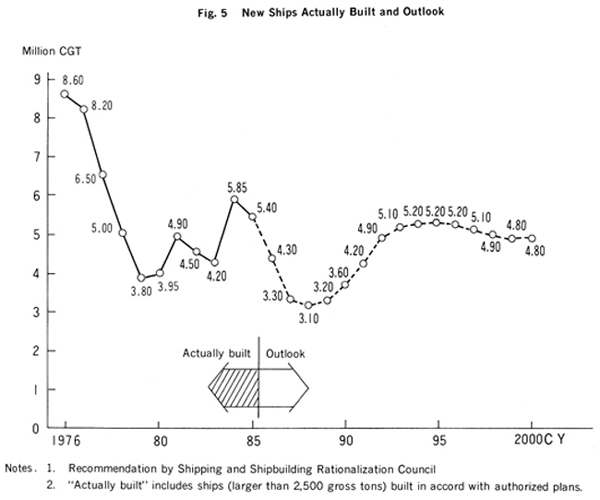
The recommendation of the Shipping and Shipbuilding Rationalization Council
in June 1986 suggested that to stabilize the nation's shipbuilding industry,
Japan should take the following measures as quickly as possible: the disposal
of excessive facilities by about 20%; the construction of the strengthened industrial
structure (regrouping, etc.); the promotion of the scrapping of vessels; and
the creation of demand for shipping. (Fig.
5) The Ministry of Transport is now studying how to implement these measures
effectively.
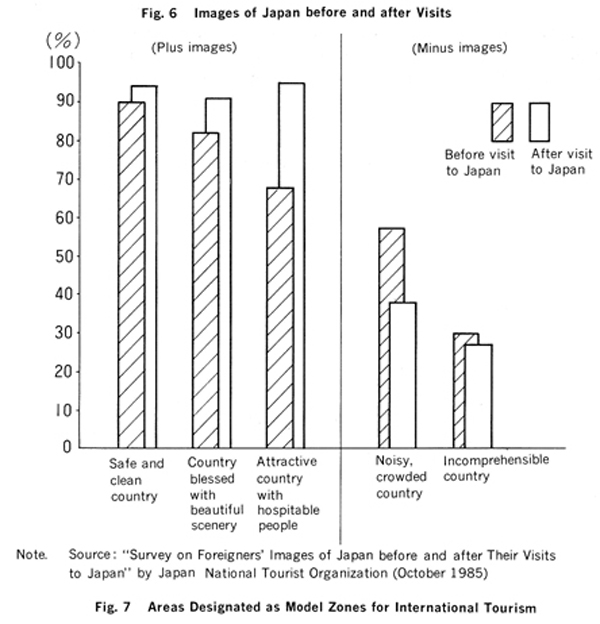
International interchanges need to be further expanded from the standpoint
of cultivating mutual understanding, and of correcting international imbalances
of payments through the promotion of tourism. (Fig.
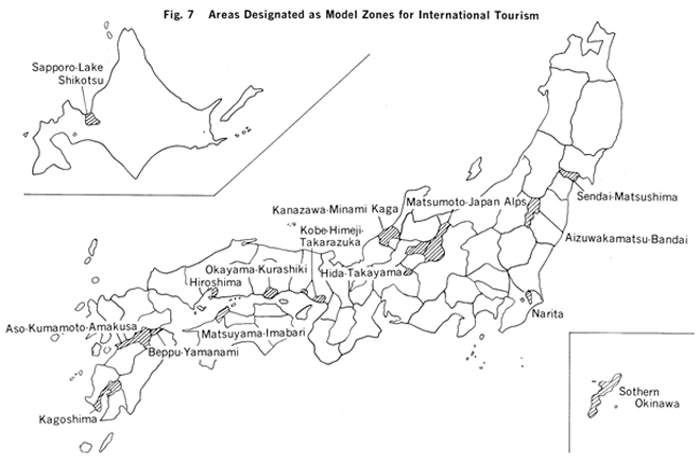
6) The Ministry of Transport has taken various measures to encourage Japanese
to travel abroad, improve steps to receive foreign tourists, such as the designation
of model zones for foreign tourists (Fig.
7), and the promotion of conventions.
The development of international air transport is a must for expanding international
personnel interchanges. International air transport was further expanded in
1986 through such measures as the inauguration of an international service by
All Nippon Airways, the establishment of new routes to Atlanta and Washington
D.C. (USA), and to Perth, Cairns and Brisbane (Australia), and the inauguration
of direct services to Paris and London over the Siberia.
(1) Promotion of External Economic Measures
①Action Program All measures contained in the "Main Points of the Action
Program for Improving Access to the Market," drawn up m July 1985 has already
been implemented As for the standards and certification for automobiles, in
particular, the "Guidelines for Imported Motor Vehicle Standards and Systems"
were decided in July 1986 with a view to further promoting the internationalization
of the standards.
②Problems Related to the Participation of Foreign Enterprises in Kansai International
Airport Project
The Kansai International Airport project is to be carried out on a corporation
formula.
The contracts system, therefore, will be decided at the discretion of the Kansai
International Airport Co. (KIAC). The Ministry of Transport is of the view that
fair and non-discriminate opportunities for competition should be given to foreign
enterprises as well in principle.
According to the KIAC, (i) it is practically difficult to let enterprises
without technological accumulation concerning the project take part in the construction
of the seawall, reclamation and the construction of an access bridge, since
the work must be started immediately, and (ii) under the designated competition
system which the KIAC has adopted in principle, every enterprise will be given
fair and non-discriminate opportunities for competition in line with the above-mentioned
policy.
In response to American requests, the KIAC held a seminar in October 1986
for American enterprises interested in this project. The KIAC has also been
making various efforts to explain its policy to other foreign countries on every
possible occasion. It is necessary for the KIAC to deal adequately with this
matter in the future.
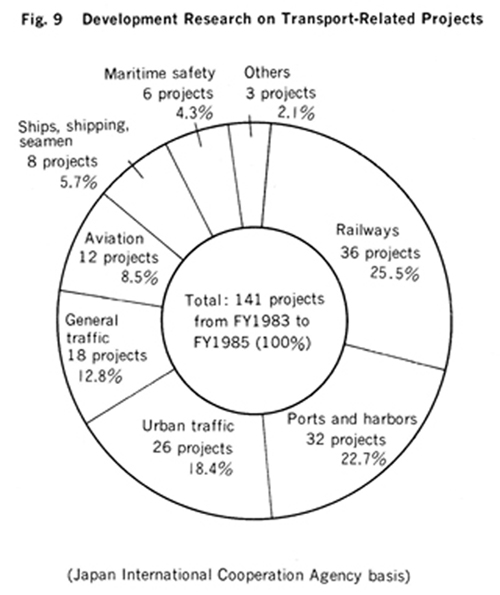
(2) Developments in International Cooperation
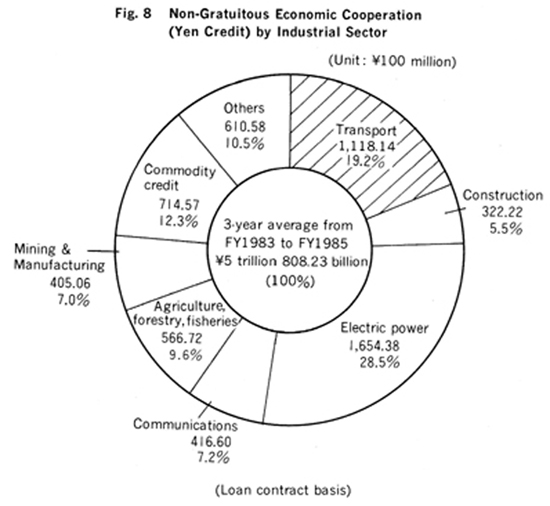
Transport facilities play a vitally important role in the socioeconomic activities
of developing countries and these facilities account for a high percentage in
Japan's economic cooperation with developing countries. (Figs.
8 & 9) In addition to requests
for such development of facilities (hardware), an increasing number of requests
have been made in recent years for the provision of technical knowhow on maintenance
and management (software), and in increasingly diverse fields. Thus, Japan is
requested to extend cooperation of higher quality.
Cooperation in tourism such as developing tourist attractions and taking
measures to receive foreign tourists is helpful in reducing the surplus in the
international balance of payments, and it needs to be positively promoted. In
fiscal 1986, research was started on regional development with emphasis on tourism,
including a basic survey for the development of the southern Pacific area.
China is the second largest recipient of Japan's yen credit, more than half
of which is related to transport projects. Interchanges with Chinese transport
officials are expanding. The second Japan-China forum of experts on railway
cooperation and the first Japan-China expert meeting on transport and traffic
were held in 1986.
(3) Promotion of International Science and Technology Cooperation
The Ministry of Transport has extended cooperation in research activities
concerning such fields as railways, ocean development, ships, electronic navigation,
ports and harbors, maritime safety and weather observation.
In fiscal 1986, an agreement was made with the Republic of Korea regarding
research on preventing the pollution of sea water. An agreement was also reached
with Canada regarding research on electronic marine charts.
The Ministry of Transport plans to further promote such research cooperation through the operation of a research exchange promotion law, instituted in fiscal 1986, including the dispatch of researchers from its affiliated organizations and the acceptance of researchers from foreign countries.
|
|
|