 |
 |
 |
JNR's net loss for fiscal 1985 reached a huge sum of \1.847,8 trillion.
Its cumulative loss at the end of fiscal 1985 totaled about Y14 trillion, and
its long-term debts about \24 trillion. JNR's reform has therefore become the
most urgent national task.
On the basis of the recommendation of the Supervisory Committee for the JNR
Reconstruction, and in line with management improvement plans, the Ministry
of Transport and JNR have been taking emergency measures, including re-employment
of its personnel, reform plans for local lines, revisions in train schedules
and rares, restraint on investments in facilities and equipment's, and effective
use of land.
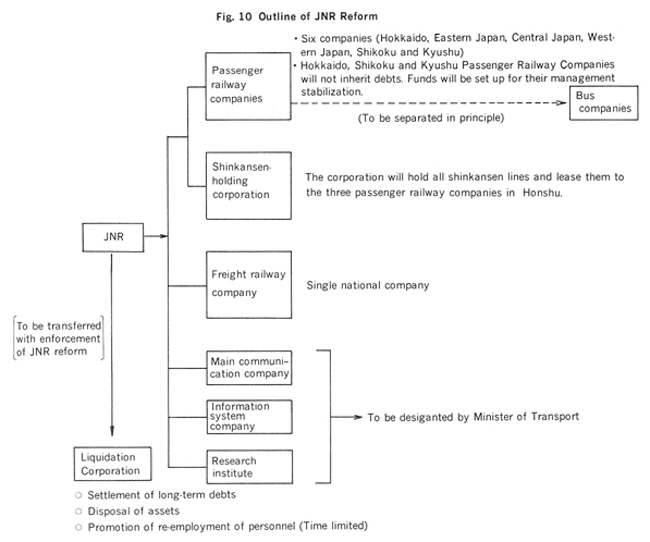
(1) Enactment of JNR Reform Bills and Start for New Management Form
A package of eight JNR reform bills was enacted at the 107th session of the
Diet, thereby paving the way for the close of JNR's 115-year history as a state-run
corporation on April l, 1987. Thus, JNR's role and operation will be carried
over to six passenger companies, one freight company, one Shinkansen-holding
corporation, and other organizations. (Fig.
10)
After the enactment of the JNR reform bills, the Government and JNR immediately
began necessary preparations for smooth transfer to a new system, and the work
is now under way.
(2) Prospects for Railway Service after Division and Privatization and Future
Tasks
①Prospects after Enforcement of Reform
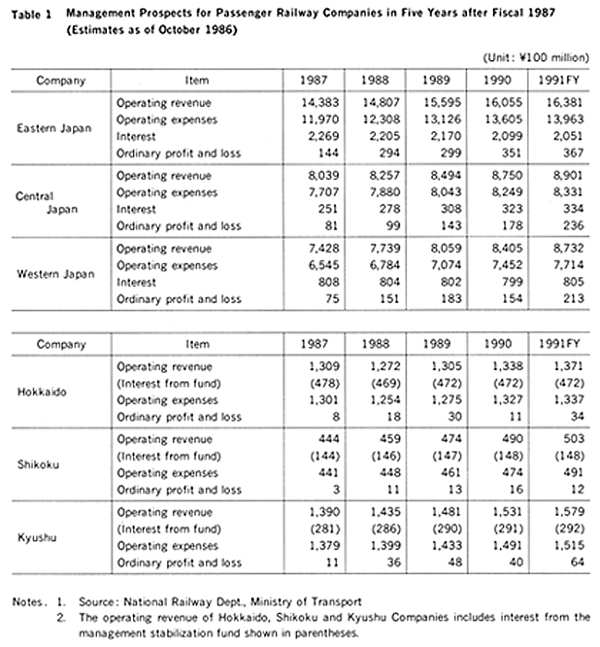
At the inception of their services, the new companies are requested to rationalize
their management setup as far as possible and inherit the long-term debts so
long as such inheritance will not cause any inconvenience to their sound and
smooth management. (The new companies in Hokkaido, Kyushu and Shikoku will be
exempted from inheriting the long-term debts; management stabilization funds
will be created for these companies.) Thus, the new companies will be able to
secure a stable business foundation and carry out a sound and vigorous business
operation by making further management efforts. (Table
1)
The new companies are expected to provide the following services:
(i) The passenger companies will place emphasis on medium-distance, inter-city
transport, as well as on the transport of commuters and students in major urban
areas; the freight company will place emphasis on long-distance, mass transport.
Both passenger and freight companies will contribute to creating efficient traffic
networks in response to their users' needs.
(ii) The new companies are also expected to contribute to regional development
in harmony with regional communities by providing traffic services emphasizing
local interests, keeping close contact with regional communities and activating
the local lines.
②Responses to Important Tasks Related to Reform
The long-term debts will belong to a new liquidation company, which will
settle them with JNR's portion of the long-term debts which may not be covered
by its own funds will finally be settled by the state. To minimize the final
burden on the state, the liquidation company will endeavor to create as much
disposable land as possible and increase the added value of such land. Before
estimates can be made on the final settlement and fiscal steps for the settlement
are studied and decided, a state subsidy will be provided to the liquidation
company so long as the national treasury permits.
As for the employment of its personnel, JNR is trying to find jobs for those
willing to leave JNR and work in other enterprises. JNR has also accepted applications
for voluntary retirement. For employees to be transferred to the liquidation
company on April 1, 1987, a comprehensive and systematic measure will be taken
to enable all of them to be re-employed within three years.
The JNR mutual aid pension system will be placed in a difficult situation
as a result of the reduction in the number of employees and the increase in
the number of pension recipients after the reform is carried out. Studies are
under way to ensure that smooth payments can be made now and in the future.
③For Successful Reform
The reform of JNR, which plays a vitally important role in the nation's transport
system, is a pressing and imperative national task in view of its critical financial
situation. This reform, therefore, must be carried out by all means.
The Ministry of Transport is determined to tackle this reform with all its
power to open a new vista in railway transport through the understanding and
cooperation of the nation
|
|
|