 |
 |
 |
In response to such movements as progressing internationalization and informatization
and diversified leisure activities, there is a growing demand for creating port
and harbor spaces for general use in which facilities for international exchanges,
advanced data processing and recreation activities are linked organically.
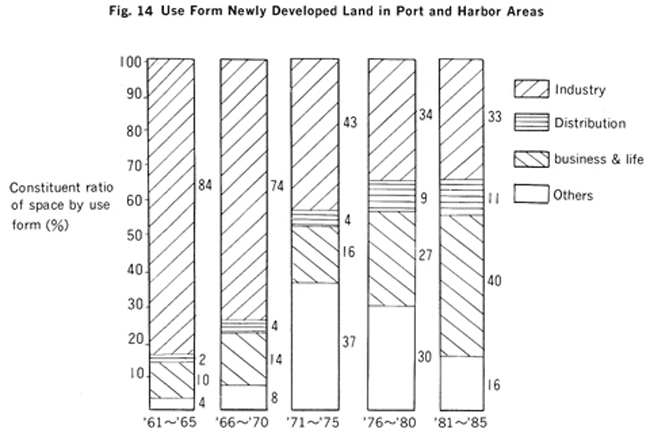
As a reflection of these needs, port and harbor spaces have been allocated
not only to the industrial production and the distribution of goods, but also
to various life-related services, and the latter's share is rising. (Fig.
14) Thus, the formation of port and harbor spaces for general use is under
way in response to such needs.
In major urban areas, there is a growing demand for the development of seaside
zones where a certain space of land can be secured, the development of ports
and harbors is actively under way in parallel with the construction of access
routes to the center of the cities.
In local areas, the development of ports and harbors is under way with emphasis
on the utilization of recreation facilities.
In creating such port and harbor spaces for general use, various development
plans are being formulated.
In fiscal 1986, the Ministry of Transport instituted a system called the
"Port Renaissance 21." This system is aimed at promoting the development of
ports and harbors in response to increasingly sophisticated and diversified
needs for such facilities, by organically combining public works with the development
of facilities by private sectors (the construction of passenger terminals, international
conference halls, etc.)
To promote the development of ports and harbors in such a way, the Ministry
of Transport plans to take various supporting measures, such as granting tax
privileges and extending loans from the Japan Development Bank and other financial
institutions under a special law for promoting the development of designated
facilities using the private sector's vitality. Thus, through cooperation between
public and private sectors, the development of ports and harbors will be carried
out with emphasis on the implementation of public work projects.
Utilizing the above-mentioned systems, the Ministry of Transport plans to
help the private sector carry out various projects for creating port and harbor
facilities for general use. In fiscal 1986, studies were conducted to promote
such projects in about 20 port cities throughout the country.
At present, plans are under way in the Takeshiba Pier area of Tokyo Port,
to create a seaside zone including such facilities as port service establishments
and multipurpose halls, in parallel with the Pier's re-development. In the 'Minato
Mirai 21' area of Yokohama Port, plans are under way to create and international
exchange zone centering on an international conference hall.
The Ministry of Transport drew up the seventh five-year port and harbor development program with fiscal 1986 as its initial year. The investment in this five-year program, including the development of related facilities, totals \4.400 trillion. This investment plan was approved at the Cabinet meeting in February 1986. The target for carrying out port and harbor development projects and the volume of work (\2.550 trillion) were decided at the Cabinet meeting in November 1986.
|
|
|