.jpg)
.jpg)
.jpg)
.jpg)
 |
 |
 |
The Ministry of Transport annually draws up safety plans for transport businesses
to ensure traffic safety as the base of transport administration, and promotes
safety measures for transport. (Fig.
15(1) (2) (3)
(4)
As for safety in air transport, in particular, the Ministry investigated
the cause of the accident of the JAL jetliner in August 1985, and immediately
confirmed the safety of other planes of the same type by conducting thorough
checks on them. While instructing the air companies concerned to step up checks
on the structure of planes and improve the design of their tails, the Ministry
strongly urged all air companies to further improve their operation and maintenance
systems.
The Ministry of Transport has taken various anti-disaster and environmental
protection measures. As for anti-disaster measures, the Ministry has drawn up
an action plan for anti-disaster, strengthened weather observation and forecasting
systems, and improved monitoring systems for earthquakes and volcanic activities.
Thus, the Ministry promotes anti-disaster measures for transport systems.
On November 21, 1986, a major eruption occurred in Izu Oshima, and caused
a critical situation. In an overnight evacuation operation using patrol vessels
of the Maritime Safety Agency, private passenger liners and other vessels, islanders
were able to leave the island before daybreak. Volcanic activities are still
being monitored, and constant vigilance is being maintained in Izu Oshima.
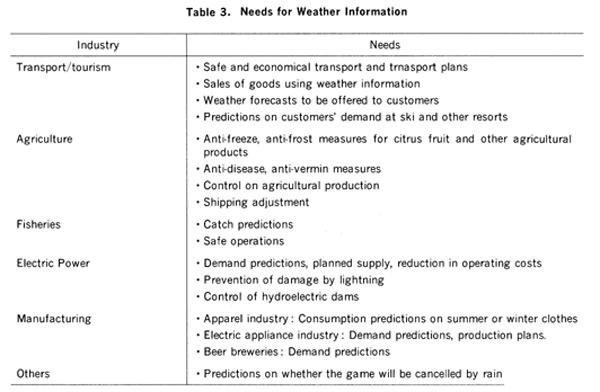
Weather has a great effect on socio-economic activities. Weather information
is of course important to our daily life. As the scope of socioeconomic activities
expands, businesses have become eager to obtain weather information so as to
minimize risks that may be caused by weather conditions. Thus, needs for weather
information are becoming diversified and sophisticated.
(Table 3)
In the form of supplementing activities of the Meteorological Agency, weather
information service organizations (at present, 15 companies including Japan
Weather Association (Inc.) and private companies), process and provide, by such
measures as telephone or telephone facsimile, weather information which meets
the specific needs of users.
To ensure that these service companies provide accurate and appropriate information,
the Meteorological Agency supplies them with necessary data, and gives instructions
to the newly established Users' Panel on Meteorological Data Application (membership:
business firms and weather information service organizations) to promote the
provision of weather information that meets users' needs.
|
|
|