Chapter 9 Transport Economy Growing Stagnant-Fiscal 1985 Overview
The growth tempo of the Japanese economy for fiscal 1985 slackened, affected
by the appreciation of the yen in the latter half of the fiscal year. In these
circumstances, the transport sector witnessed two different phenomena, one of
which is an increase of passenger transport and the other a leveling-off of freight
transport. Also, as regards transport business operations, there was difference
according to the type of business, but transport businesses as a whole, many of
them battered by structural recession, had great difficulty
9. 1 Trends in Transport
(1) Trends in Passenger Transport
①Domestic Passengers
Domestic passenger transport in fiscal 1985 totaled 53.87 billion passengers
(an increase of 1.7%), and 858.2 billion passenger kilometers (an increase of
3.1%), over the previous fiscal year, respectively, favorably affected by factors
such as a steady increase in consumer spending and an active flow of domestic
passengers owing to the International Science and Technology Exhibition. Both
passenger transport and passenger-km in fiscal 1985 exceeded those in the preceding
fiscal year in terms of the increase rate (by 0.8% and 1.2% respectively).
(Table 4)
The following are features of passenger transport in fiscal 1985:
(i) Despite increase in fares, the number of JNR passenger increased for three
straight years due partly to the revision of the timetable in March 1985;
(ii) Air transport recorded a decrease for the first time in three years, affected
by the crash of the JAL jetliner in August 1985;
(iii) The increase rate of private cars resumed an upward trend;
(iv) Automobiles other than those for private use registered an increase over
the previous fiscal year for the first time in five years, affected by a drastic
increase in the number of buses for private use.
(Fig. 20)
Domestic air transport, which had remained affected in fiscal 1986 by the previous
year's JAL accident, is indicating signs of a gradual recovery.
Tentative calculations estimate the loss of air transport passengers due to
the JAL accident at about 4.4 million, 10.7% of the total, during the period since
the accident through June 1986. (Fig.
21)
After the JAL accident, the volume of passenger transport by the JNR increased
on various lines; in particular, first class passengers registered a rapid increase
on the Tokaido and Sanyo Shinkansen lines.
②International Passengers
As for trends in international transport in fiscal 1985, the number of out-going
Japanese during the year totaled 4.95 million, recording an all-time high for
four consecutive years. (Table 5)
The number of in-coming foreigners totaled 2.33 million, also registering an
all-time high for 10 straight years. This was because of a drastic increase in
the number of business as well as the International Science and Technology Exhibition,
which drew a multitude of tourists from Asian countries.
In fiscal 1986 the number of foreign visitors to Japan decreased reflecting
reaction to the increase of visitors to Tsukuba Exp. '85 and the yen's appreciation.
(2) Trends in Freight Transport
①Domestic Freight
An overview of trends in domestic freight transport in fiscal 1985 shows that
the total tonnage of transport decreased by 1.3% to 5.6 billion tons, recording
a decline for five straight years, while the total tonnage-km of transport almost
leveled off, registering 434.4 billion tonnage-km, a decrease of 0.1%.
The following are features of freight transport in fiscal 1985:
(i) Coastal shipping, which had registered an increase for the last two consecutive
years, decreased in terms of transport tonnage-km;
(ii) The JNR reduced its decrease rate of freight transport;
(iii) With the result that coastal shipping decreased in terms of transport
tonnage-km, and commercial vehicles increased, the share of automobiles in freight
transport (47.4%) became on a par with that of coastal shipping for the first
time. (Fig. 22)
As for trends in the volume of domestic freight transport over the past 10 years,
the volume, which had registered a smooth increase over the first half of the
past decade, indicated a tendency toward stagnation in the latter half.
The following are background circumstances for this situation:
(i) People are growing less "material-oriented" with the weight of consumer
spending on goods reduced amidst the evolution of service-oriented economies;
(ii) In secondary industries there is a trend for the manufacturing industry
production to grow stagnant on a quantitative basis, affected by the so-called
miniaturization/compactization phenomenon wrought by a progressive shift from
a raw material-type industry to a processing and assembly-type industry, and by
the growth of high technology industry. (Fig.
23)
By commodity, the transport of coastal shipping transport-oriented goods (coal,
cement, etc.) decreased appreciably whereas that of truck transport-oriented goods
(vegetables, fruit, food industry products, etc.) and intermediary transport-oriented
products (grain, chemical products, etc.) are displaying an upward trend. As regards
intermediary transport-oriented products, their rate of transport by the JNR was
relatively high in fiscal 1980, but a shift to transportation by truck became
conspicuous in fiscal 1984. (Fig. 24)
Also, a look at changes in the average transport distance shows that it increased
notably in the case of cars for commercial use in particular.(Fig.
25)
②International Freight
As for the volume of international freight transport (on a tonnage basis) by
oceangoing shipping in 1985, exports and imports resumed a downward trend, the
former by 2.6% and the latter by 1.0%, averaging 1.2% altogether.
(Table 6)
In the case of the volume of international air freight transport (on a tonnage
basis) in 1985, exports and imports were up 3.7% and 9.1% respectively, averaging
6.0% altogether, but the rate of increase slackened in each case.
9. 2 Development of Facilities
(1) Public Investments Public investments in transport-related facilities in
fiscal 1985 totaled \8.904,6 trillion a marginal 2.4% increase over the previous
fiscal year.
The figure is broken down to \1.832 trillion for railways (down 12.7%), \633.6
billion for ports and harbors (down 0.1%), \216.6 billion for airports (up 3.8%),
and \6.971,2 trillion for roads (up 5.4%).
(2) Private-Sector Equipment Investments
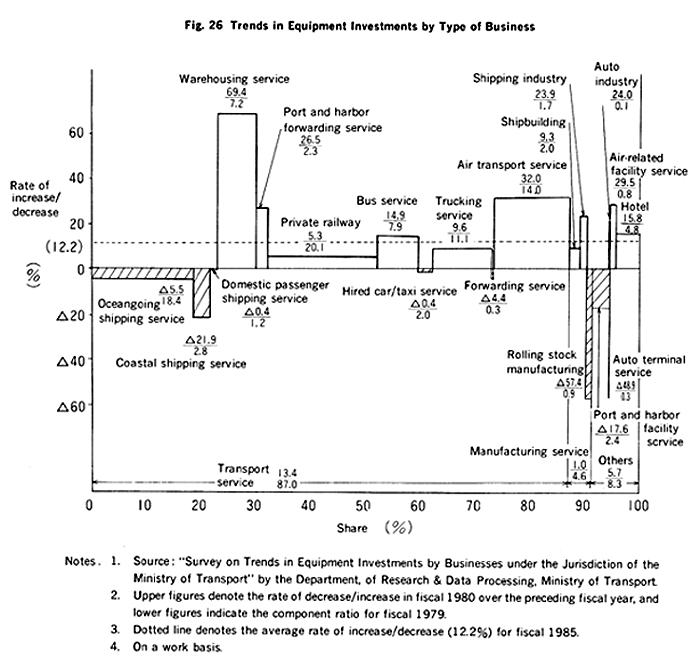
According to a survey by the Ministry of Transport, transport-related private-sector
equipment investments (3,731 firms with a capital of more than \50 million polled)
for fiscal 1985 totaled \1.548,3 trillion, up 12.2% from the previous fiscal
year, recording a two-digit increase for the first time since fiscal 1979.
(Fig. 26)
As for fiscal 1986 the plans totaling \1.481,4 trillion, down 4.3% from the
preceding fiscal year, are rather prudent, reflecting the recent business conditions.
The ratio of contracts for new leases to equipment investments has been on
the increase yearly, 6.1% in fiscal 1984, 8.5% in fiscal 1985 and 9.6% in fiscal
1986 (on a plan base), following the more leasing trend (a shift from "possession
to utilization,") also in the transport business.
9. 3 Business Conditions
The feature of business conditions in the transport sector for fiscal 1985
was an increase of businesses facing stagnation, affected by factors such as
a decline in the increase rate of operating income.
Looking at trends in the rate of current balance for fiscal 1985, the rate,
as a whole, leveled off or decreased.
(Fig. 27(1)(2)) By sector:
① In the railway sector, business conditions of the JNR and public railways
worsened;
② In the motor vehicle sector, business conditions were inactive with the
exception of scheduled trucks;
③ In the shipping sector, business conditions remained acute;
④ In the air service sector, earnings registered a sizable drop.
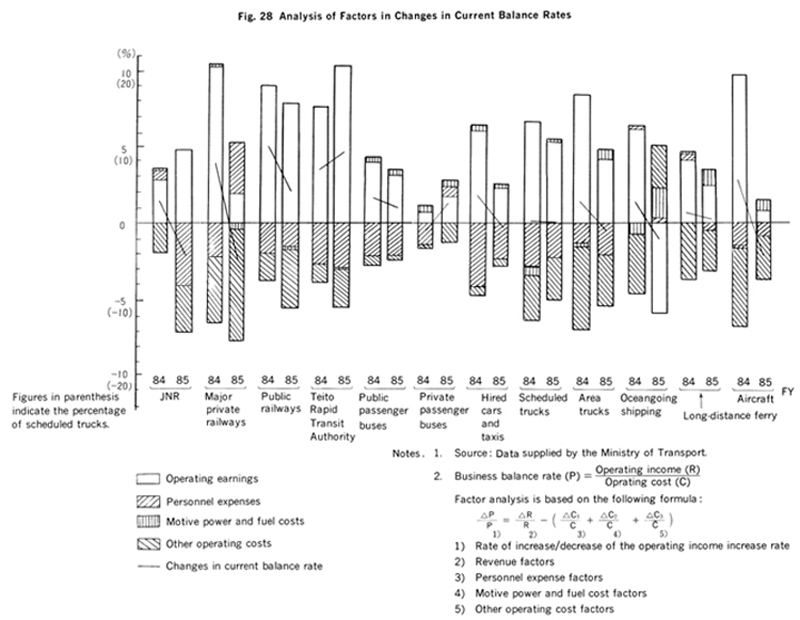
As regards business conditions in the transport sector for fiscal 1985, the
yen appreciation and a drop in the price of crude oil helped reduce fuel costs,
but a decline in or a leveling-off of operating income contributed a great deal
to the deterioration of the current balance.
(Fig. 28) The yen appreciation has slowed down the pace of the nation's
business upturn. In these circumstances, it would be difficult to expect a continued
drastic increase of operating income, hence all the firms involved are urged
to exert greater endeavors to curb their business costs and to increase their
earnings.
.jpg)
.jpg)