 |
 |
 |
(1) Review of Transport Regulations
As regards transport regulations, there is a constant need to review their
appropriate application so as to cope with ever-changing socio-economic conditions,
and steps to improve such regulations have so far been implemented whenever
necessary, in the basis of such a concept, while steps have been taken with
regard to matters specified in recommendations submitted by the Ad Hoc Council
for the Administration Reform.
Major Reviews currently carried out are as follows: the vast improvement
of regulations governing railways in line with the reform of the JNR, the consolidation
of oceangoing shipping, and the review of airline business management systems.
(2) Utilization of Private-Sector Vitality in Transport
The basic approach to the utilization of private-sector vitality in transport
may be roughly divided into the three following categories:
(a) Privatization of the public-utility sector; (b) effective utilization
of land owned by the JNR; and (c) introduction of private-sector funds and management
knowhow to develop projects providing public facilities.
It is in this context that the development of the projected Kansai International
Airport and the redevelopment of ports and harbors are currently being accelerated.
Also, with the promulgation and enforcement of the so-called "Private-Sector
Vitality Law" in May 1986, it is expected that such projects as the redevelopment
of the Takeshiba area in Tokyo Port, Yokohama's "Minato Mirai 21" plan and others
will be launched during the fiscal 1986-87 period.
It is said that "an era of new services," in which services based on new
concepts will arise one after another in industrial structural changes, has
been ushered in of late, amidst the gradual emergence of distinctive social
(trends or economic service-, soft-, information- and high technology-) toward
the 21st century.
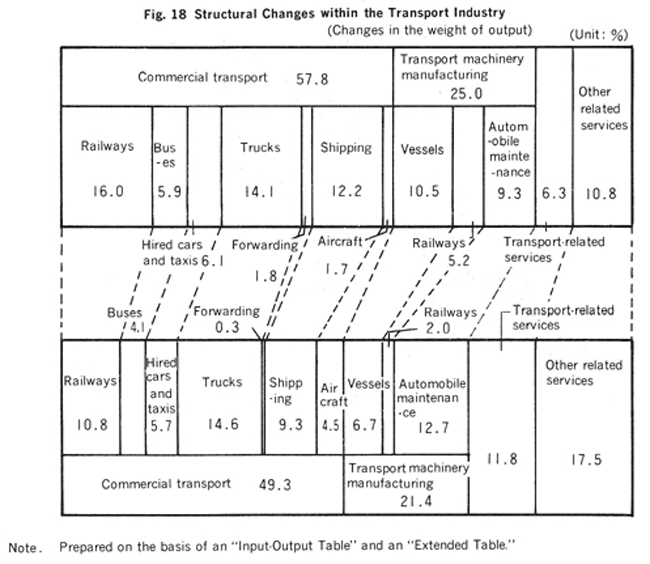
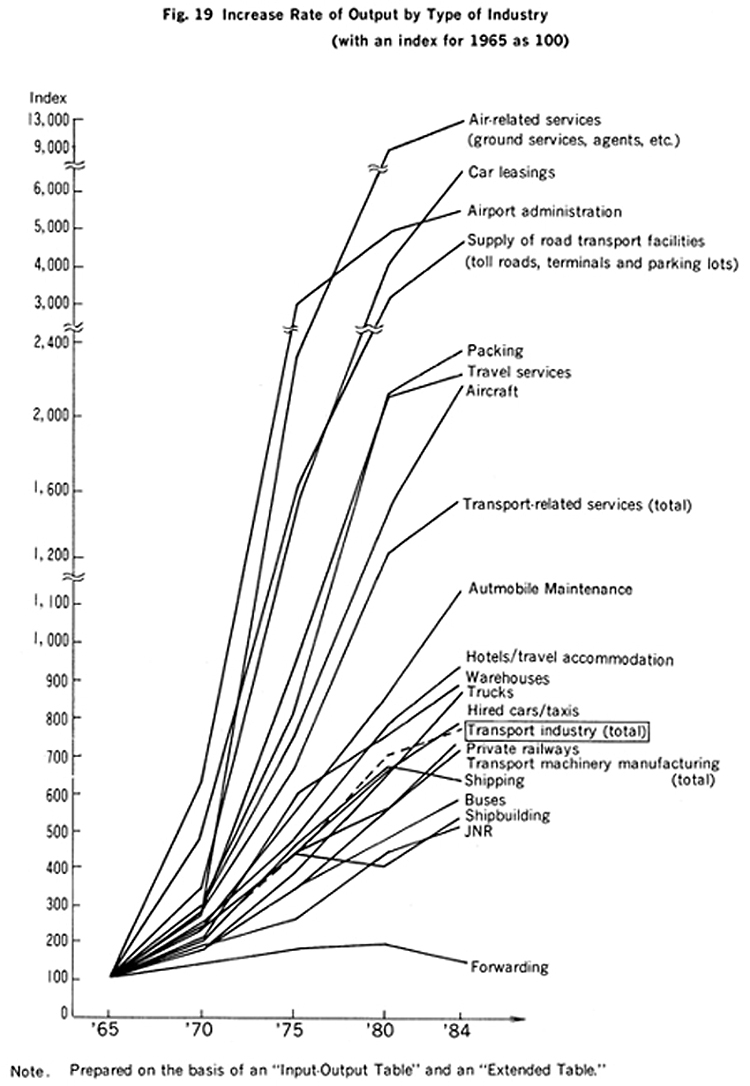
Such trends are in evidence also in the transport industry (Figs.
18&19), where diversified
home delivery services (including delivery of local specialties), integrated
house-moving services, courier services, convention-related services, weather
information services, information and telecommunication services, etc., are
exemplified.
Such moves are gaining impetus in the shape of (a) sophistication and diversification
of existing services, (b) inauguration and development of new-type services,
and (c) infiltration of transport entrepreneurs into other areas of business.
Those new services in transport, which have invariably made their debut to
meet the needs of the times, are attaining rapid development of late. According
to a survey by the Ministry of Transport, such services have already developed
into a \5 trillion market, even when only taking in account some of the 130
firms polled, whose market size has been clarified.
In regard to the prevailing trends in new services, appropriate measures
have been positively taken in recent years, including the establishment of standard
regulations governing home delivery, house-moving and trunk-room services. But
there are still many problems requiring closer study
As regards administrative steps to be taken in the future, it is considered
necessary to (a) continuously grasp the actual status of the new services, (b)
foster and extend guidance to the kind of services whose social needs are high
and which must be promoted in view of their public interests, and (c) organize
the service industry and foster service organizations. At present, such problems
are being studied.
In order to develop Japan's economy and to further improve the nation's
living standards, there is a need to strive for the development and use of the
oceans coping positively with the changing times including greater importance
of the utilization of people's leisure time. And to this end, it would be necessary
to supply fullfledged maritime information and carry out the development of
maritime exploration technologies, and to push ahead with projects such as (i)
the construction of man-made offshore islands and ii) the promotion of maritime
recreations.
The Ministry of Transport, in an effort to further disseminate public knowledge
on oceans and maritime affairs, decided to sponsor an annual "sea festival"
starting in fiscal 1986, and the first festival was held in Kita-Kyushu city.
In order to fully meet the demand for greater safety and convenience of transport systems which are being sophisticated and diversified, there is a need to vigorously push for the development of transport-related technologies, including the introduction of high technologies.
|
|
|