 |
 |
 |
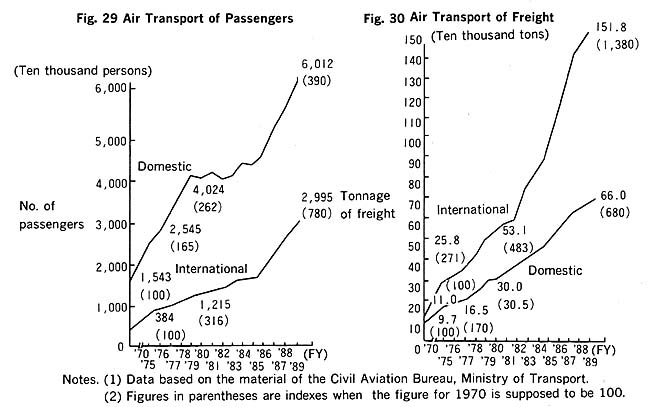
Air transport in Japan has made rapid progress in terms of passenger and cargo volumes, against the backdrop of the increasing pace of life. Defined today as the principal means of long-distance transport, air transport is expected to continue to grow smoothly.
(1) Present Status of Air Transport
The Ministry of Transport is currently forging ahead with international
service route operations by plural airlines and double- and triple-tracking
of services on domestic routes in an effort to improve the convenience for users
through the stimulation of competition among airlines while basically securing
safety operations in line with the purport of "What the future management system
of airlines should be," set forth in recommendations presented in June 1986
by the Council for Transport Policy. In these circumstances, demand for air
transport in Japan has smoothly expanded on both domestic and international
service routes (Fig. 29 and
Fig. 30).
(2) Air Fares
Reductions in domestic air fares were carried out on June 1, 1990, for 27
service routes to rectify differences in air ticket prices per service route
on the basis of a report titled "Problems Concerning Domestic Air Passenger
Fares," compiled on December 15, 1989, by the Air Fares Problem Council, a private
advisory panel to the director-general of the Civil Aviation Bureau, the Ministry
of Transport. At the same time, the Ministry of Transport, since April 1990,
has been pushing ahead with the gradual introduction and expansion of discount
airfares in a bid to alleviate the substantial fare burdens of users. With respect
to international airfares, too, the Ministry of Transport has so far extended
guidance to the airlines involved so that they could rectify bi-direction differences
in air ticket prices with an emphasis on fare reductions for flights departing
from Japan. Meanwhile, Japan has raised airfares to cope with soaring crude
oil prices. At the same time, it is currently pushing ahead with the introduction
and expansion of discount fares, including APEX fares, for European and Pacific
service routes.
(3) Present Status of International Air Transport
Over the past year (September 1989 to August 1990), Japan pushed ahead with
air negotiations mainly over expanding air service route networks, through talks
with 19 of the 39 countries with which it has concluded air agreements.
Again, the opening of regular international service routes to local airports
has been making rapid headway in recent years, and the internationalization
of local airports has become an important agenda item at air talks.
|
|
|