 |
 |
 |
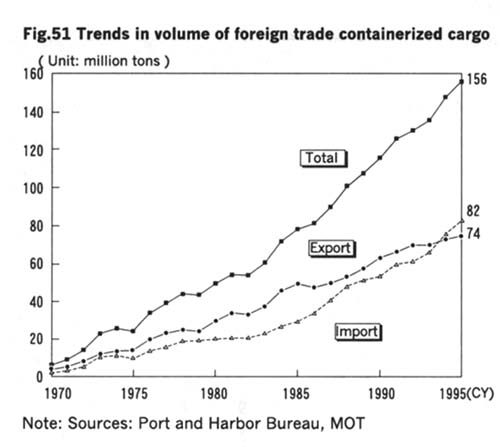
International marine container transportation is currently
playing a main role in international physical distribution. With the industrial
structure changing, the volume of import container cargo has been increasing
dramatically (Fig. 51).
The center of container distribution businesses has been shifting from Japan
to neighboring Asian countries whose economies are growing rapidly, and consequently
Japan's position in the harbor transportation business is down.
The Ministry is making efforts to develop and manage ports and harbors efficiently
to create an effective distribution network, which contributes to stronger international
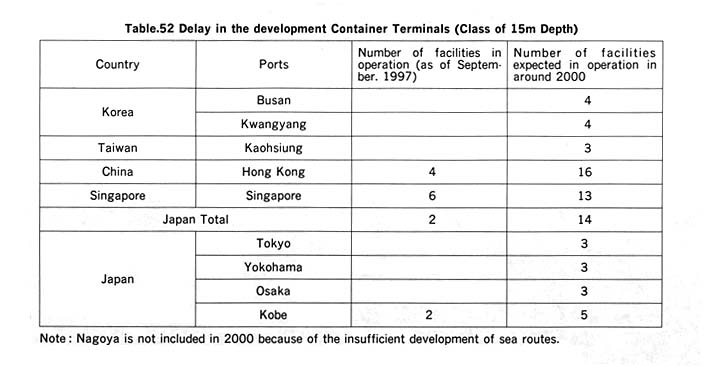
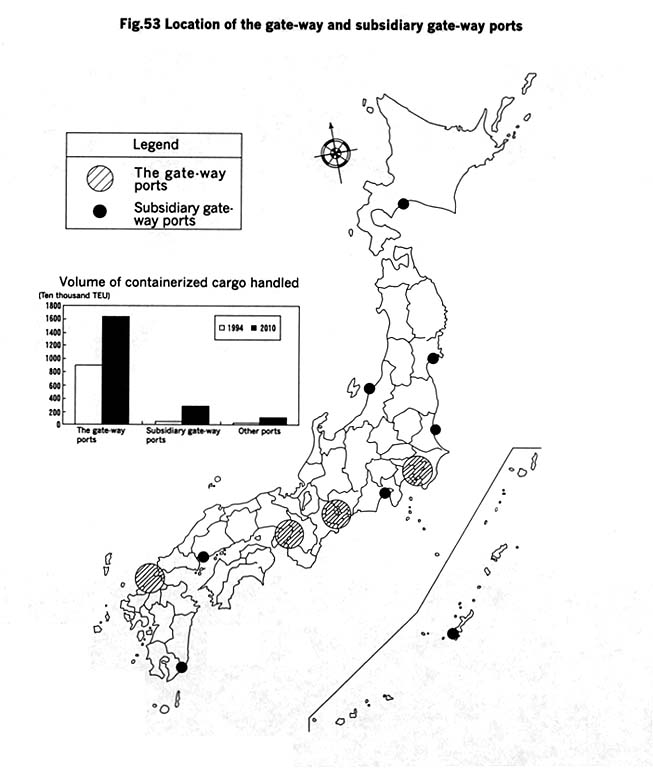
competition and reduced distribution cost. Those efforts include the development
of deep-water container-terminals, the repair of which is being delayed (Table
52), the development of the gate-way and subsidiary gate-way ports (Fig.
53), and the strategic distribution of domestic intermodal transport terminals.
The Ministry is making efforts to create more user-friendly ports and harbors through simplification and computerization of inbound and outbound clearance and reduced fees for port and harbor facilities.
The Ministry is making efforts to create vital and lively ports and harbors
which contribute to the improvement of quality of living.
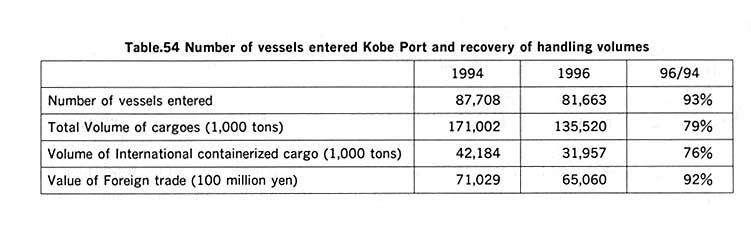
The Port of Kobe has been steadily recovering since the Hanshin-Awaji Great
Earthquake Disaster, January 1995 (Table
54), and continues to make efforts to developquake-resistant ports and harbors.
Furthermore, the Ministry is smoothly managing the designation and changes
of harbor districts, and also promoting effective utilization of coastal spaces.
For the safety and comfort of citizens' Iifestyles, the Ministry is engaged in developing coastal districts and managing water-front works effectively and efficiently to keep these water-fronts safe and clean.
|
|
|