



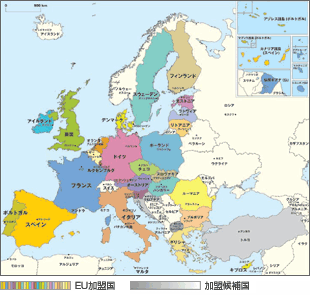
The European Union (EU) is a new type of federation of countries comprised of 28 European countries pursuant to the founding treaty, and its origins go back to the European Coal and Steel Community (ECSC) founded in 1952. Through five subsequent enlargements, the number of member states increased from the original six to 28 to expand into a region with a population of 500 million. The European Union has achieved unification and integration in areas such as taxation and customs, economic policies, markets, and currency (Euro).
History of EU Expansion
- 1958 (EC)
- Founding Members: the Federal Republic of Germany, France, Italy, Belgium, the Netherlands, and Luxembourg
- 1973 (EC)
- First Enlargement: United Kingdom, Ireland, and Denmark
- 1981 (EC)
- Second Enlargement: Greece
- 1986 (EC)
- Third Enlargement: Spain and Portugal
- 1995 (EU)
- Fourth Enlargement: Austria, Sweden, and Finland
- 2004 (EU)
- Fifth Enlargement: Poland, the Czech Republic, Hungary, Estonia, Latvia, Lithuania, Malta, Cyprus, Slovakia, and Slovenia
- 2007 (EU)
- Fifth Enlargement: Bulgaria and Romania
- 2013 (EU)
- Sixth Enlargement: Croatia
TableProfile
| Surface Area | 4.290 million km² (11 times that of Japan) |
|---|---|
| Population | 582.0 million (Eurostat; est.) |
| Population density | 118/km² (2017) |
| Percentage of urban population | 74% of the population lives in cities of more than 5,000 inhabitants (2009.7: EUROSTAT) |
| GDP | USD 16220.4 billion (2015: IMF World Economic Outlook) |
| GDP per capita | USD 37,852 (2015: IMF World Economic Outlook) |
| GDP growth rate (real) | 0.2% (2013), 1.4% (2014), 2.0% (2015) 1.8% (2016), 1.9% (2017) (2016.5: EU) |
(Information Updated: March 2017)
Organizational Structure of EU
The EU has unique legislative, judicial, and administrative organs (see table on the right) for the purpose of achieving its objectives.
Table:Overview of EU's Organizational Structure
| European Council (EU Summit) | The supreme political authority of the EU that steers the EU politically and set the direction of its policies. Permanent chairperson (President of the European Council) was created under the Lisbon Treaty. |
|---|---|
| Council of the European Union (Consilium) | Comprised of representatives from member states, it engages in legislative matters together with the European Council. It also serves as the only decision-making authority within the EU regarding common diplomatic and security policies and within the police and judicial association. |
| European Council | Comprised of 785 members appointed by direct election, the Council participates in the legislation procedures, together with the Consilium, as a representative of the European public, while exercising democratic control over the EU's activities. |
| European Commission | As the administrative authority of the EU, it implements the EU's policies. As the only EU authority with the right to submit legislative bills, the Commission engages in the legislation of the EU's laws. |
| European Court of Justice | It serves the role of ensuring correct interpretation and implementation of the fundamental treaties of the EU. |
Major Policies of European Union and Structure of European Commission
The EU engages in policy areas where acting in concert as the EU is in the benefit of member states, such as economy, social matters, regulations, and finance. The EU's policy departments are located within the European Commission, which is the executive branch of the EU, with the Directorate General for Regional and Urban Policy handling regional policies.
Major Authorities Relating to Spatial Policy
| Administrative Area | Authority | Web Site |
|---|---|---|
| Overall | European Commission | http://ec.europa.eu/index_en.htm |
| Delegation of the European Union to Japan | http://www.euinjapan.jp/en/ | |
| Statistics | EUROSTAT | http://epp.eurostat.ec.europa.eu/portal/page/ portal/eurostat/home |
| Regional policies | Directorate General for Regional and Urban Policy | http://ec.europa.eu/regional_policy/index_en.htm |
| Cooperation, studies, etc. on spatial policies |
ESPON, European Spatial Planning Observation Network | http://www.espon.eu/ |

With 41% of the populations and 48% of the GDP of the EU are concentrated in a centrally located region surrounded by North Yorkshire, Franche-Comté, Hamburg, and Milan, the Preamble of the Treaty of Rome of 1957 already calls for balanced development through the correction of of regional disparities. By 2004, the per capita GDP of higher ranking regions accounting for approximately 10% of the GDP amounted to as much as five times that of the lower ranking regions accounting for 10% of the population.
The framework of the EU's current Cohesion Policy dates back to the Single European Act of 1986. The concept having been inherited by the Maastricht Treaty (1993), regional policies were enhanced as the number of member states increased and have come to account for approximately one third of the EU's total budget. The expansion of the Union in 2004 to include the former Eastern Europe having resulted in an increase in regional disparities, the EU is developing various measures as it transfers its emphasis on the relevant regions.
Although spatial planning does not fall within the scope of the EU's authority, there have been such moves as the formulation of the European Spatial Development Perspective (ESDP) through unofficial governmental cooperation. Since spatial development was placed in the charge of the EU as a result of the inclusion of Territorial Cohesion in the Treaty of Lisbon, which went into effect in 2009, the EU is endeavoring to promote its authority to coordinate various spatial policies, as well as to facilitate cooperation among the parties responsible for land use and development planning. In recent years, strategies for multilateral areas have been considered that covers Baltic Sea coastal area, Danube River area, etc.
Current Status of EU's Regional Policies
The objectives of EU's regional policies are aimed at achieving balanced development, social, economic and territorial cohesion, while aggressively implementing measures relating to growth and employment, countermeasures for climate change and energy issues and reduction of poverty and social exclusion, which are the objectives of the Europe 2020.
- Characteristics and Concept
- The intent of the current regional policies is not the mere transfer of income from the affluent countries to the poor countries, but also the provision of support for the programs aimed at resolving regional issues. In addition to placing importance on partnerships among member states, regions, the EU and various other entities in the execution and implementation of these policies, such efforts as policy evaluation and monitoring are being made to enhance the effect of the policies.
- Support Mechanism
- Financial aid is provided over a number of years through funds such as the Structural Fund to regions subject to support, which are selected from among the base group of 274 regions (counted in terms of provinces and similar regional units) to supplement and thereby promote national, regional, and private investment from a medium-term perspective (the budget for the 2014-2020 period is 351.8 billion euros, which is 32.5% of the total budget of EU).
- Framework of the Cohesion Policy 2014-2020
<Character of the new Cohesion Policy>
- Cohesion Policy 2014-2020 have the Goals "Investment in Growth and Jobs" and "European Territorial Cooperation" and it has been through revision such as; targeted growth, accountability and results, pre-conditions for funding, appropriate financial instrument, etc.
- - Classification of the targeted areas
Targeted areas will be divided into three regions;"less developed regions" whose GDP per capita is less than 75% of the average of 27 EU countries, "transition regions" with the rate 75% up to less than 90% and "more developed regions" with the rate more than 90%, and shares of financial contribution of EU and each country will be decided according to such classification. - - Focused support to prioritized themes
Approximately 100 billion euros will be invested to 11 thematic objectives which are; (1) strengthening research, technological development and innovation, (2) enhancing access to, and use and quality of ICT, (3) enhancing the competitiveness of SMEs, (4) supporting the shift towards a low-carbon economy in all sectors, (5) promoting climate change adaptation, risk prevention and management, (6) preserving and protecting the environment and promoting resource efficiency, (7) promoting sustainable transport and removing bottlenecks in key network infrastructures, (8) promoting sustainable and quality employment and supporting labour mobility, (9) promoting social inclusion, combating poverty and any discrimination, (10) investing in education, training and vocational training for skills and lifelong learning, and (11) enhancing institutional capacity of public authorities and stakeholders and efficient public administration.
European Regional Development Fund (ERDF) will be targeted in particular on themes (1)-(4). Moreover, there are certain rules, for example; at least 26 billion euros should be invested to the field of low-carbon economy. - - Types of funds
Funds used are European Regional Development Fund (ERDF), European Social Fund (ESF), Cohesion Fund and also funds related to agriculture and fishery.
More revision have been made such as; formulation of preconditions for funding, simplification of procedures, urban policy, reinforcement of cross-border cooperation, etc.
<Procedures>
- Member countries of EU are to submit Partnership Agreement (PA) which sets out development priorities towards achievement of the goals of Europe 2020 to European Commission within four months from the entry into force of the Regulation. European Commission is to make observations within three months after the agreement's submission and will adopt no later than four months after submission regarding the responses from the countries. Before November 2014, PA was adopted between all of the 28 countries.
- Member countries are to submit Operational Programs (OP) after at least three months have passed after their submission of PAs. European Commission is to make observations within three months and will adopt no later than six months regarding the responses from the countries. About 535 programs are under negotiation or adoption procedure to be adopted until summer 2015.
- Prior to the submission of PA, European Commission has published a document showing its standpoint on priorities of each country's usage of fund.
Goals Category of regions Allocated fund Funds Purpose Investment in growth and jobs less developed regions: GDP per capita is less than 75% of the average of 27 EU countries 182.17 billion euros ERDF
ESFSupport for the most less-developed regions to catch up transition regions: GDP per capita is 75% up to less than 90% of 27 EU countries 35.38 billion euros Support for the regions which are recently becoming competitive but still need targeted encouragement more developed regions: GDP per capita is more than 90% of 27 EU countries 54.35 billion euros Promotion of improving international competitiveness in knowledge economy or making transition to low-carbon economy European Territorial Cooperation 96.23 billion euros ERDF Promotion of multilateral and inter-regional cooperation over the borders
Figure:Applied areas of Cohesion Policy 2014-2020
(Red indicates regions subject to convergence)
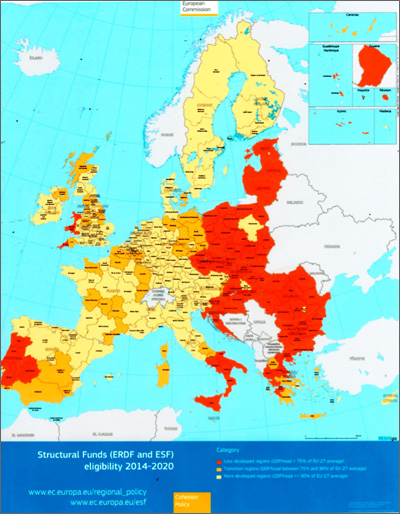
Source: European Union
Territorial Cohesion — EU and Spatial Development
In the Treaty of Lisbon that went into effect in December 2009, territorial cohesion was incorporated into the provisions together with economic and social cohesion.
The Green Paper on Territorial Cohesion (2008) states that territorial cohesion signifies enabling the population to take full advantage of the territorial characteristics by guaranteeing the harmonious development of the EU's diverse territories and is a means of converting this diversity into an asset that contributes to the sustainable development of the EU overall. However, the definition of the term "territorial cohesion," the role to be played by the EU, the forms of territorial cooperation, manners of coordinating territorial policies with sectoral and national policies, manners of participation in the design and implementation of policies, and the development of indices are specified subjects for future discussions and are still being debated.
(Information Updated: March 2015)

