


Country Profile
The population of the UK amounts to 12.3% of that of EU, the third largest among the member states.
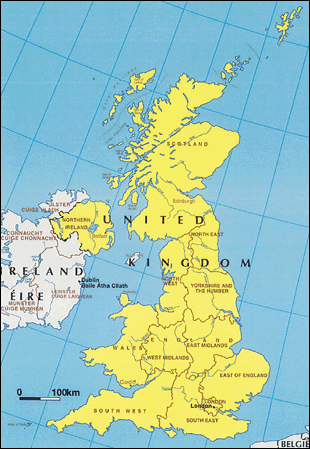
The UK is made up of England and three other countries that have different forms of devolved government: Wales, Scotland and Northern Ireland. While the three countries are impacted to a degree by the laws passed by the assembly of London, the assembly of each country is able to pass its own laws within certain limits.
This webpage describes mainly about England.
TableUK fast facts
| Country name | United Kingdom of Great Britain and Northern Ireland |
|---|---|
| Surface area | 243,000 km² (about two-thirds of that of Japan) |
| Population | 65.11 million (2015) |
| Population density | 268/km² |
| Percentage of urban population | 82.6% (2015) |
| GDP | GBP 1,659 billion (2008) GBP 1,589 billion (2009) GBP 1,614 billion (2010) GBP 1,646 billion (2011) GBP 1,665 billion (2012) GBP 1,701 billion (2013) GBP 1,750 billion (2014) GBP 1,789 billion (2015) (IMF, British Statistics Bureau) |
| GBP 1,519 billion (2008) GBP 1,486 billion (2009) GBP 1,556 billion (2010) GBP 1,619 billion (2011) GBP 1,655 billion (2012) GBP 1,735 billion (2013) GBP 1,817 billion (2014) GBP 1,864 billion (2015) (IMF, British Statistics Bureau) |
|
| GDP per capita | GBP 24,750 (2008), GBP 24,044 (2009) GBP 24,989 (2010), GBP 25,596 (2011) GBP 26,139 (2012), GBP 27,072 (2013) GBP 28,132 (2014), GBP 28,634 (2015) (IMF, British Statistics Bureau) |
| Percentage of employment by industry | agriculture: 0.6% industry: 19.2% services: 80.2% (2016 est.) |
| Economic growth rate (real) | ▲0.5% (2008), ▲4.2% (2009), 1.95% (2010) 2.0% (2011), 1.2% (2012), 2.2% (2013) 2.9% (2014), 2.2% (2015) (IMF, British Statistics Bureau) |
(Information Updated: March 2017)
Local Governments
Multiple types of autonomous bodies coexist in the local government system of England, which has been subjected to frequent reviews.
| Capital city of London | Unitary (City of London and boroughs) In 2000, the Greater London Authority (GLA) was established that has a directly elected mayor and an assembly. Its authority is limited to planning certain regional policies. |
|---|---|
| Six metropolitan areas | Unitary (metropolitan districts) |
| Other areas | Unitary or two-tiered (county and district) |
Local Governments and Spatial Planning System
Major Authorities Relating to Spatial Policy
| Administrative Area | Authority | Web Site |
|---|---|---|
| Spatial planning | Department for Communities and Local Government (reorganized in 2006) | http://www.communities.gov.uk cf. Planning Portal: http://www.planningportal.gov.uk/ |
| Regional and industrial policies | Department for Business, Energy & Industrial Strategy | http://www.bis.gov.uk/ |
| Plans for Greater London | Greater London Authority | http://www.london.gov.uk |

In the UK, the framework for the spatial planning system was established by the Town and Country Planning Act of 1947. Although the current system generally dates back to the Town and Country Planning Act of 1990 and related laws, material amendments were made in 2004 and 2011 with respect to England and Wales.
Regional policies heavily oriented towards employment measures were implemented after the Great Depression. Although various support measures geared towards specific regions were implemented since the 1960s, regional policies were not necessarily been high on the priority list since the days of the Thatcher Administration. In the 1990s, measures directed at enhancing competitiveness that were not region specific and also took the EU's regional policies into consideration were implemented. Furthermore, eight Regional Development Agencies (RDAs) were established in England in 1999. Later on RDAs were abolished along with the change of administration in May 2010 and now Local Enterprise Partnerships (LEPs) based on the partnership within local governments and private enterprises are being encouraged.
Spatial Planning in England
- Planning system before the change of government in 2010
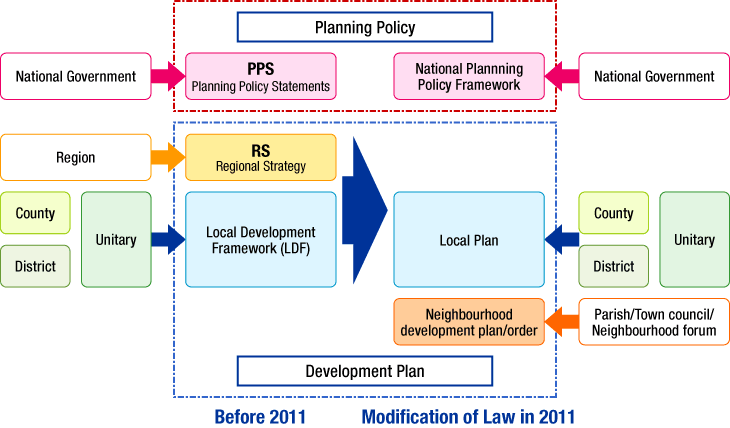
- The central government has been presenting the Planning Policy Statements (PPS)setting forth the government's national policies for spatial planning by theme, in addition to the Regional Spatial Strategy (RSS) setting forth the spatial development policy for overall region for each of the nine regions of England.
- Meanwhile, local councils have been formulating Local Development Frameworks (LDF). RSS and LDF were given the status of statutory development plan and they had been the basis (partially) of Local Planning Authorities' decision upon management of Planning Permission system which included permission for individual development.
- However, the new Conservative-Liberal Democrats coalition government from May 2010 advocates Localism, and reflecting the fact that former planning system including Regional Spatial Strategy took a top-down and bureaucratic approach and could not play a sufficient role in housing provision, the government set out a policy to abolish wide-area plan and to reform the planning system into a system more focused on communities, which lead to the enactment of Localism Act in November 2011.
- Current Town and Country Planning System
<Framework provided by the Central Government>
- The central government published National Planning Policy Framework(NPPF)in March 2012, which sets out the principle of planning in England. The content in the NPFF must be considered among the establishment of Local Plans and Neighbourhood Plans which are to encourage; building a strong, competitive economy; ensuring the vitality of town centres; supporting a prosperous rural economy; promoting sustainable transport; supporting high quality communications infrastructure; delivering a wide choice of high quality homes; requiring good design, promoting healthy communities; protecting Green Belt land; meeting the challenge of climate change, flooding and coastal change; conserving and enhancing the natural environment; conserving and enhancing the historic environment; and sustainable use of minerals. However, in contrast to the volume of PPGs exceeding 1,000 pages, NPFF was provided as a brief document less than 60 pages. Also specific infrastructure projects are not provided in the document.
<Duty to Cooperate>
- Localism Act 2011 stated "Duty to Cooperate", which is a rule that when establishing Development Plan an establishment body of a Local Plan (such as local councils) must cooperate with adjacent planning authorities and related organizations on cross-boundary strategic issues. The exemplified issues that should go through cooperation process are; homes and jobs, commercial development, infrastructure, health, security and cultural infrastructure, climate change mitigation and adaptation, etc.
Regional Policy of England
<Local Enterprise Partnerships>
After the abolition of RDAs, establishment policy of Local Enterprise Partnership (LEP) was presented in Budget 2010 in order to advance regional economic development. LEP is a business-lead partnership of public, private and academia of which more than a half of committee members are to be from private sector, and it takes functional economic area in account. Currently in 2014, 39 LEPs are approved to cover the whole area of England. Some of the LEP areas overlap each other.
LEP also acts to gain funds through competitive bidding such as Regional Growth Fund and it cooperates with local councils in establishing Local Plan. Moreover, LEP is going to be the management authority of EU Structural Fund for 2014-2020.
<Enterprise Zones>
Enterprise Zone was newly established in 2011 by the coalition government (in fact, such zone existed during the Thatcher Administration). This was to support start-up and enhancement of company's economic activity by providing incentives such as giving tax benefit, simplifying procedures related to urban planning, providing support to organize broadband environment, etc. Specific areas within LEP areas are designated as EZs and in 2014 there are 24 EZs.
<Regional Growth Fund>
Regional Growth Fund is a fund aiming at supporting investment by private sector toward economic development and continuous job security. Total fund of 3.2 billion pounds is expected during 2011-2017. Application to use this fund is allowed to the project whose budget is over one million pounds but it will not be accepted when the project body consists of public sector only --- the fund should be applied by private sector or public-private joint body such as LEP (LEPs can apply but no priority will be given). It is regarded that the fund created private investment of 16 billion pounds and employment of more than 100 thousand.
<City Deals>
In order to promote economic growth of the cities/city regions that bear important roles in England's long-term growth, the government and cities/city areas are to conclude City Deals to transfer necessary authority and financial resource. Content of the deals differs depending on each city/urban regions. The first attempt of this agreement was concluded with eight large cities excluding London (Birmingham, Bristol, Manchester, Leeds, Liverpool, Nottingham, New Castle and Sheffield) (all of which were targeted at city regions and most of the cities take LEP as the core player). For its second term, negotiation is going on with 20 other cities.
<Growth Deals>
Growth Deals is an agreement between the government and LEPs to vitalize local economy, and it aims at building cooperation between the two players. The government is to give assistance to LEPs through Local Growth Fund to enhance flexibility and discretion in LEPs' activity. LEPs are to establish strategic economic plan in negotiating with the government and will implement the plan. Example of the contents of the deals includes job training for young people, creation of new employment, provision of new housings and development of transport/information infrastructure. Projects of total 6 billion pounds had met agreement for the first term of which assistance by LGF for 2015-2016 is going to be 2 billion. In January 2015, additional assistance (1 billion pound) by LGF was announced.
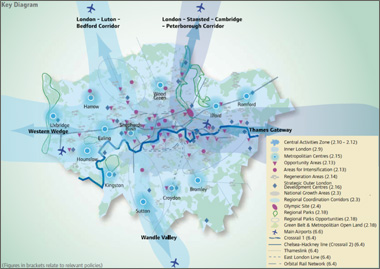
Source:Mayor of London (2011) "THE London Plan :Spatial Development Strategy for Greater London"
Metropolitan Spatial Planning: London
The Greater London Authority Act requires the City Mayor to formulate a spatial development strategy for London, based on which the London Plan that replaces the traditional strategic guidance was devised in February 2004. The Local Plan for each borough is generally expected to be in alignment and other strategies formulated by the City Mayor are required to be consistent with the London Plan.
Under the new mayor Johnson elected in 2008, the new London Plan was formulated in July 2011. Target year of the plan is 2031 and the policies stated are based on the strategies including; meeting the challenges of economic and population growth (such as improving quality-of life), enhancement of international competitiveness (having strong and diverse economy, etc.), creation of diverse, strong, secure and accessible neighbourhoods, formulation of the city that delights the senses (buildings and streets, heritage, etc.), becoming a world leader in improving the environment (tackling climate change, etc.), improvement of convenience and safety to access jobs, opportunities and facilities (such as improvement of transport system), etc.
Spatial Planning in Countries Other than England
Unlike England, each of the other three countries formulates its spatial plans based on systems specific to the country. There is a trend in some countries to position spatial plans as regional strategies that reach beyond land use plans.
| Wales | Basis Laws | The Planning and Compulsory Purchase Act 2004 obliges the assembly of Wales to establish Wales Spatial Plan and The Government of Wales Act, 2006 treats this plan as a policy to form a framework covering broad range of fields such as economic development, etc. In October 2014, a new draft of planning act (Planning (Wales) Bill 2014) was submitted to the assembly of Wales for the purpose of enhancing plan-led approach, dealing with strategic issues, etc. |
|---|---|---|
| Plan | "People, Places, Future---The Wales Spatial Plan 2004"(amended in 2008) Draft of the new planning act includes National Development Framework for spatial planning of Wales and regulations on designation and planning of strategic development area that coves multiple local authorities. |
|
| Northern Ireland | Basis Laws | Basic content of spatial planning is stipulated in The Planning(Northern Ireland) Order, 1991. |
| Plan | "Regional Development Strategy for Northern Ireland (RDS)" "Shaping Our Future---Regional Development Strategy for Northern Ireland 2025" was established in September 2001. RDS2025 was amended in 2008 and a new strategy "Regional Development Strategy 2035---Building a Better Future" was established in March 2012. RDS supplements Northern Ireland government's policy from the spatial viewpoint and it presents long-term spatial strategy for public/private sectors. Also correlation with national spatial strategy of Ireland is considered, and in July 2013, "Framework for Co-operation --- Spatial Strategies for Northern Ireland and the Republic of Ireland" was established. |
|
| Scotland | Basis Laws | Based on The Town and Country Planning (Scotland)Act, 1997 |
| Plan | "NATIONAL PLANNING FRAMEWORK FOR SCOTLAND" This is the long-term strategy presenting the framework of Scotland's spatial development. With the background of decentralization of government and ESDP in 1999, the 1st NPF was established in 2004 followed by the 2nd in 2009, then the 3rd in June 2014 (NPF was legally recognized from the 2nd NPF). At the same time, Scottish Planning Policy was established which presented the Scotland government's policy on urban planning management and land use/development. NPF3 presents 14 national developments including development of transport infrastructure, development of major urban areas, green network, etc. As a statutory Development Plan, local authorities (single-tiered) establishes Local Development Plan. The four major urban areas (Aberdeen, Dundee, Edinburgh, Glasgow) are to establish Strategic Development Plans which is a cross-boundary plan. |
(Information Updated: March 2015)

